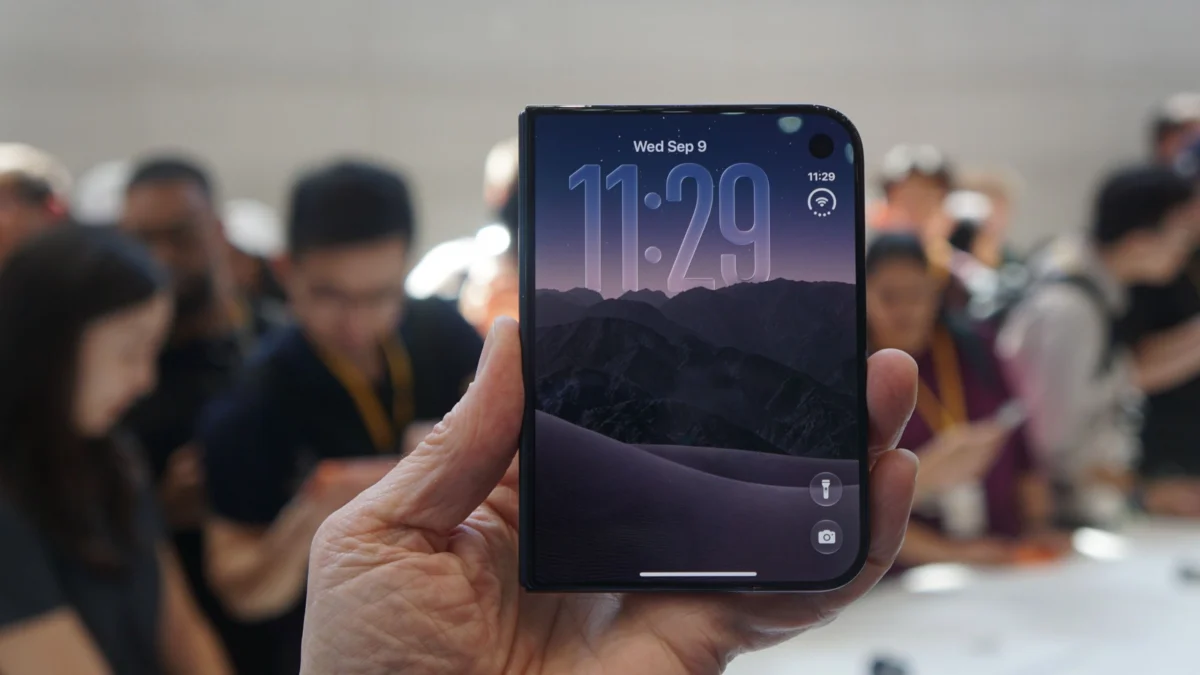
Store employees have been told to caution shoppers without preorders against expecting walk-in units on launch day.
Apple has told store staff to caution shoppers without a preorder that units of the new iPhone Duo will be limited when the handset arrives in stores on Friday, October 23, TechRadar reported. Employees speaking to MacRumors said Apple advised them that customers should not expect to walk into an outlet and buy the foldable device on its release day.
The retail notice follows an immediate surge of buyers that pushed delivery estimates into January and 2027, as previously covered when iPhone Duo shipping slips took place within hours of reservations opening.
Demand strains supply across retail channels
Friday, October 23 marks the official launch date when preorders begin shipping to buyers and in-store sales open. However, instructions shared with retail staff suggest customers without an existing reservation will struggle to secure a device immediately. The report noted that it is not yet clear whether the guidance given to retail employees applies worldwide or only in the United States.
Online supplies have already dwindled. Delivery estimates for the base 256GB model currently point to January across the United States, the United Kingdom and Australia, where the device sells for $1,999, £1,999 and AU$3,499. Rumors prior to the phone’s reveal had pointed to possible production problems causing launch delays. Apple previously described early interest in a statement shared with CNBC, calling preorder levels “nothing short of extraordinary”.
Market watchers expect heavy sales for the hardware despite the supply constraints. Counterpoint informed Bloomberg that sales of the device could hit 6 million units during 2026 alone, Engadget reported. Reviewers have described the release as Apple’s “most exciting device in a decade”.
Hardware specifications and market timing
The iPhone Duo represents Apple’s debut in the foldable category. When folded, the handset is passport-sized. It features an external 5.4-inch display alongside a 7.6-inch internal screen, carrying an entry price of $1,999.
The release follows years of Apple holding off on entering the foldable sector while competitors tested the technology. The company previously took a similar approach with touchscreen devices, choosing to wait until initial technical problems had been solved by others before releasing its own hardware.
How foldable phones developed
The commercial foldable market began in 2019, when Chinese display maker Royole showed the FlexPai at CES. Reviewers at the time considered the device rough around the edges and janky, though it confirmed that flexible OLED panels could work in consumer hardware. Samsung followed in February 2019 with the original Galaxy Fold, priced just under $2,000. Reviewers reported broken screens after peeling away a protective plastic layer, prompting Samsung to recall review units and delay the commercial debut to re-engineer the phone.
Other manufacturers experimented with competing form factors. Huawei introduced the Mate X at MWC 2019 with an outward-folding display, but the exposed screen was vulnerable to scratches, and sanctions under Donald Trump prevented its sale in the United States. Huawei later shifted to an inward fold on the Mate X2.
Between 2020 and 2025, Android manufacturers resolved key structural weaknesses. Samsung added ultra-thin glass to the Galaxy Z Flip in 2020, then introduced IPX8 water resistance on the Galaxy Z Fold 3 and Z Flip 3 in 2021. Dust resistance followed later, reaching IP48 on the Galaxy Z Fold 6 and full IP68 protection on Google’s Pixel 10 Pro Fold in 2025. Oppo addressed the display crease on the Find N in 2021, while Honor and Samsung cut down chassis thickness on the Magic V series and Galaxy Z Fold 7.
Device makers also cut costs, with clamshell models such as the rebooted Motorola Razr and the $999 Galaxy Z Flip 3 lowering prices toward typical flagship territory.