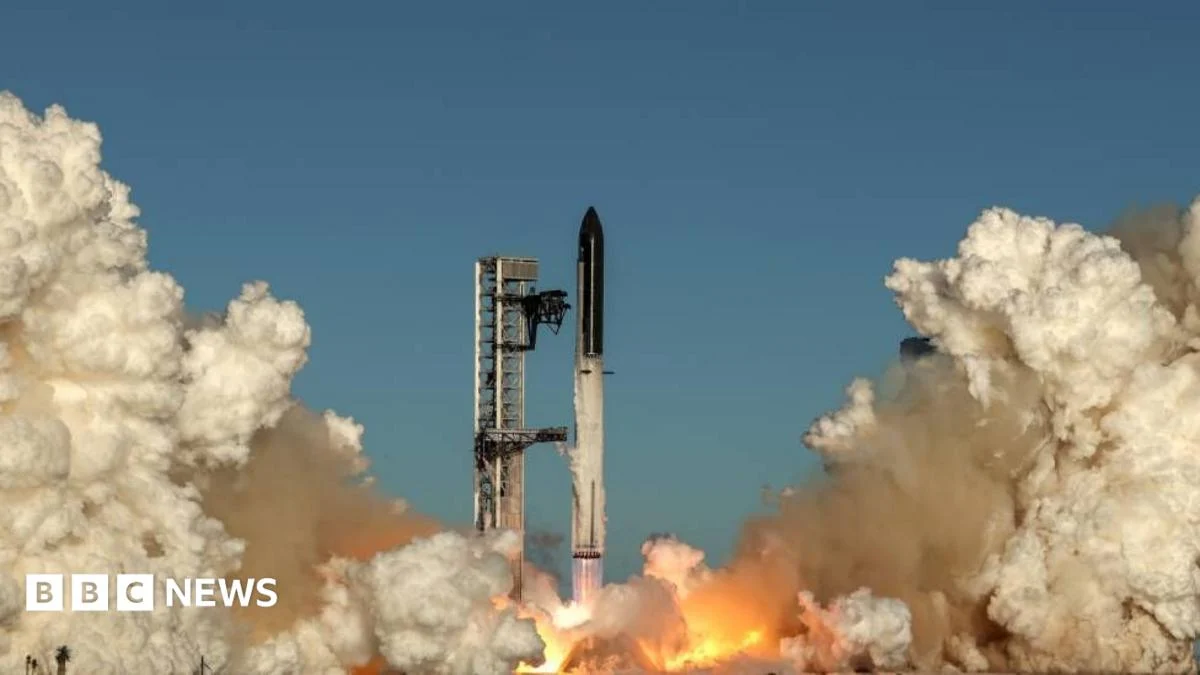

Mechanical arms caught the Starship spacecraft as it returned to its Texas launch site on Saturday. The first-of-its-kind recovery marks a milestone for the rocket program despite the loss of its booster a day earlier.
SpaceX caught its returning Starship spacecraft out of the air with giant mechanical arms at its Texas launch pad on Saturday, completing the first recovery of the vehicle from orbit.
The flight was a continuation of Friday’s test, when the Starship upper stage reached orbit after separating from its Super Heavy booster, which ran into problems during its descent and crashed in the Gulf of Mexico.
How the catch unfolded
As CBS News reported, the Starship plunged back to Earth after 22 hours in space, glowing red from atmospheric friction as cameras mounted on its steering fins beamed back live views. The stainless steel spacecraft crossed the Baja Peninsula and northern Mexico before flying just north of the launch site on the Texas coast.
The ship dropped belly first out of low clouds, then restarted three of its six methane-fueled Raptor engines to flip upright. It slowed to a near hover as two large mechanical arms on the launch tower closed around it, securing the vehicle moments before the engines shut down.
“This is so incredible to see!” said SpaceX commentator Jessie Anderson during the company’s broadcast.
Starship completed 14 laps around Earth at an altitude of 165 miles, far exceeding the one to two laps logged during a previous orbital test, according to PBS NewsHour. The spacecraft also deployed 26 advanced Starlink satellites during the mission, and SpaceX reported that the heat-shield tiles and flight systems functioned properly throughout reentry.
Booster explosion cuts short double catch
SpaceX aimed to catch both the Super Heavy booster and the Starship upper stage on the same mission, but the booster failed shortly after liftoff on Friday. The two-stage rocket stands 407 feet tall and is the most powerful launch vehicle ever built, generating around 16 million pounds of thrust at liftoff from 33 first-stage Raptor engines.
The company had caught Super Heavy boosters on three earlier test flights, but Friday’s booster ran into trouble on its descent. SpaceX’s Kate Tice explained that the booster engines stopped firing too early on the way down, Al Jazeera reported. The vehicle’s guidance system recognized it was out of position and automatically directed it away from the pad to destroy itself over the Gulf of Mexico.
The booster ran out of fuel and exploded moments before hitting the water, leaving floating debris that was later cordoned off with buoys. SpaceX founder Elon Musk said on X that the failure was caused by slight engine underperformance. Musk added that the ship and booster designs used for the flight were already outdated by newer versions in production, and he said the booster loss won’t change the company’s development schedule.
What happens next for moon and Mars goals
Saturday’s test marked the 15th flight of a full-scale Starship since 2023 and only its second mission to reach orbit. SpaceX officials said the midair capture proves the spacecraft can be fully reused, which the company views as necessary to lower launch costs for deep-space missions to the moon and Mars.
NASA leadership welcomed the successful landing. “It was almost magic,” NASA Administrator Jared Isaacman wrote on X.
NASA is paying billions of dollars for a modified Starship to serve as the human lunar lander for its Artemis program. Because the spacecraft uses most of its propellant reaching orbit, SpaceX must prove it can refuel Starships in space by launching multiple Super Heavy tanker flights before a ship can travel to the moon. SpaceX plans to begin orbital refueling tests over its next several test flights.
The space agency is also preparing Blue Origin’s Blue Moon Mark 2 lander as an alternative option. SpaceX expects to expand operations by launching Starships from NASA’s Kennedy Space Center in Florida within the next few months. Artemis III will send four astronauts to Earth orbit to test docking with both Starship and Blue Origin’s lander, ahead of Artemis IV, which NASA is targeting for as early as 2028 to return astronauts to the lunar surface.