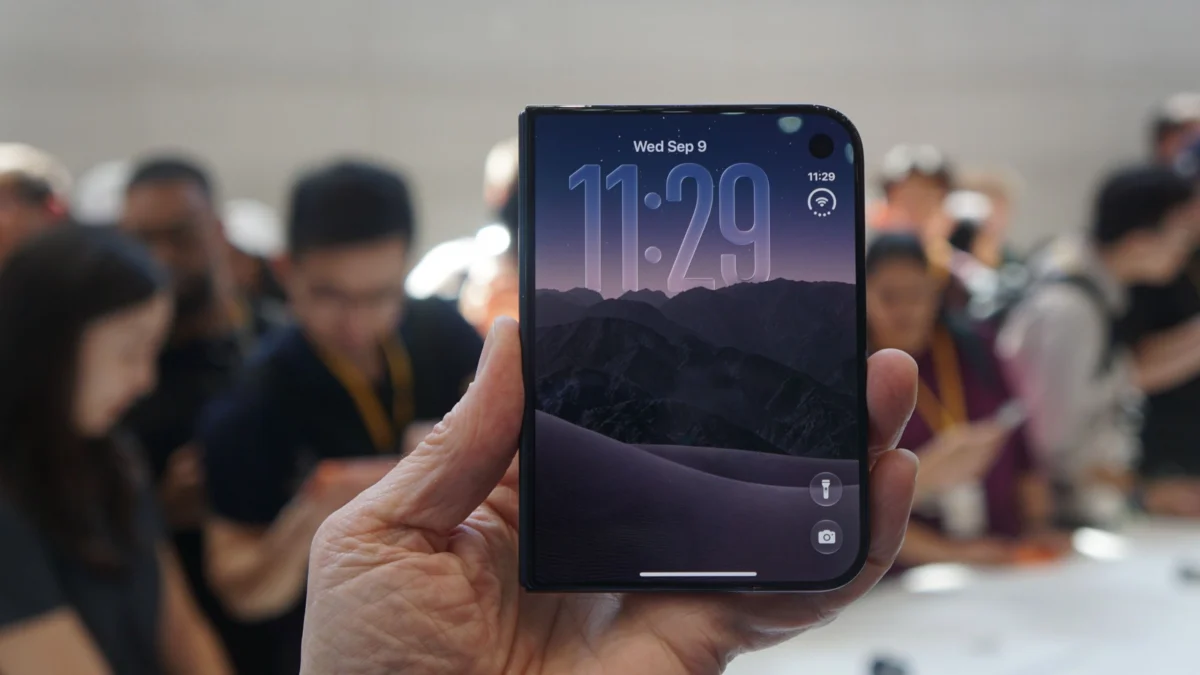
Initial reviews of Apple’s first foldable smartphone highlight strong hardware and an invisible crease alongside a steep price and heavy frame.
First reviews of the Apple iPhone Duo praised the device’s polished titanium build and screen design while raising concerns about its weight, lack of Face ID, and $1,999 opening price.
Apple introduced the foldable phone on September 9, 2026, during its Surprise and Shine event, marking the company’s first entry into the category under chief executive John Ternus. Testers describe the hardware as a hybrid between a small handset and an iPad mini, pairing a 5.4-inch exterior screen with an unfolding 7.6-inch tablet display.
The reviews come as Apple prepares for customer deliveries after warning shoppers that walk-in stock will be limited at launch.
Display design and crease handling
A central focus of testing was the main folding display, which uses a matte nanotexture finish to diffuse light and minimize the visible fold line. TechRadar reported that while the crease is not completely eliminated, it remains virtually invisible during everyday use and cuts down reflections under bright sunlight.
The matte layer on the internal flexible panel can be removed if picked at, though Apple can replace it for a $49 fee, according to Engadget. The outlet cautioned that Apple provides no setup warning telling users to avoid peeling the layer, unlike Android competitors.
Both screens reach a peak brightness of 3,000 nits and support refresh rates between 1Hz and 120Hz. The two publications gave contrasting specifications for the screen resolutions. TechRadar listed the 7.6-inch inner display at 1878 by 2670 and the cover display at 1398 by 2034, while Engadget reported that the 5.4-inch outer panel runs at 1878 by 2670 and the larger interior screen at 1398 by 2034.
Hardware specs and software changes
The iPhone Duo runs on an A20 Pro processor with 12GB of RAM, sharing the core silicon found in the iPhone 18 Pro. It features an IP68 rating for water and dust resistance, matching only Google’s Pixel 11 Pro Fold line among foldables sold in the United States.
The titanium hinge contains more than 100 components, allowing the phone to stay open at various angles. Folding dimensions measure 84.1 by 117.8 by 11.3 millimeters, expanding to 164.6 by 117.8 by 5.2 millimeters when unfolded. At 254 grams, reviewers noted the handset feels heavy in hand and in pockets, weighing over 25 percent more than Samsung’s competing Galaxy Z Fold 8.
Rather than using Face ID, Apple built a Touch ID fingerprint sensor into the side lock button. The company explained that this maintains consistency with devices like iPads and gives the phone time to display lock screen notifications before opening.
Software changes in iOS 27 shift the traditional dock and status icons to the right side of the screen on both displays. While this placement allows users to reach apps with a right thumb, TechRadar noted it narrows the usable area for standard apps on the 5.4-inch cover screen. Engadget found that many third-party apps still require developer updates to display properly on the wider aspect ratios. Multitasking features allow users to snap apps side-by-side or pin app pairs together so both launch at once.
Pricing and what happens next
The iPhone Duo starts at $1,999 in the United States, £1,999 in the United Kingdom, and AU$3,499 in Australia for a 256GB configuration. Higher storage tiers reach 512GB, 1TB, and a 2TB top tier priced at $3,199. Apple also offers monthly leasing options ranging from $57 to $83 in the US.
The phone includes an approximate 4,800mAh battery that supports 60W wired charging and 35W wireless charging. The camera system features two rear 48-megapixel lenses for wide and ultra-wide shots, an 11-megapixel front camera on the cover, and a 4-megapixel camera on the inside screen.
Support for digital pen input with the Apple Pencil is scheduled to arrive soon. Engadget noted that stylus support will arrive later this month, while TechRadar reported it is expected by November.