
Images from the European Space Agency show NASA’s DART collision flattened a wide area on the asteroid and set it tumbling.
The European Space Agency’s Hera spacecraft has revealed that a 2022 NASA collision carved a stadium-sized crater into the asteroid Dimorphos and set it tumbling in space. Observations collected from 25 to 30 kilometers away show the impact flattened the entire width of the struck face, as The Register reported. The findings offer the first close view of the asteroid since the Double Asteroid Redirection Test intentionally crashed into it.
What Hera saw at the impact site
Hera captured the new images using its monochrome Asteroid Framing Camera, the multi-spectral Hyperscout H, and a Thermal Infrared Imager developed by JAXA, Engadget reported. Dimorphos measures 151 meters wide and orbits a larger, 730-meter companion named Didymos.
Researchers previously debated how the asteroid responded to the strike. Patrick Michel, Hera’s principal investigator and director of research at CNRS and the Observatoire de la Côte d’Azur, explained that “scientists debated whether Dimorphos had sustained an impact crater, changed its shape or stayed the same.” Michel noted that the asteroid did all three at once. The impact flattened the targeted side into a massive crater, changed the overall shape of Dimorphos, and left surrounding boulder fields on the rest of the asteroid unaltered.
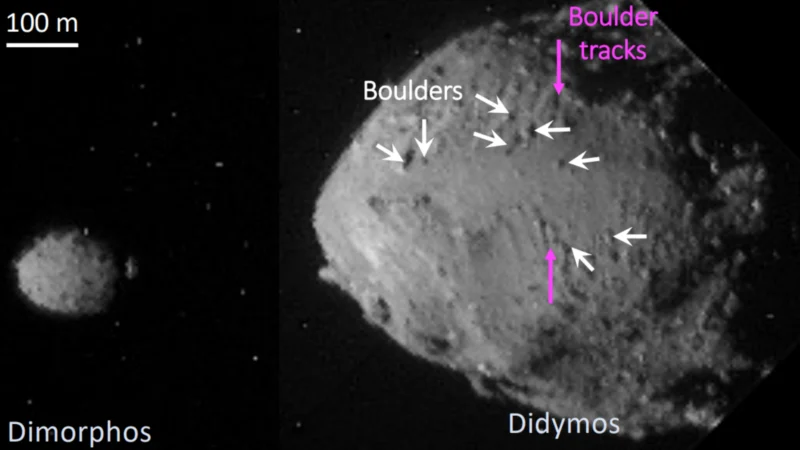
Hera also discovered that both Dimorphos and Didymos are surrounded by hundreds of loose boulders orbiting through space. To track the two asteroids, Hera flies at roughly 12 centimeters per second. Instead of following a conventional circular path, the probe uses thruster firings to steer through rectangular trajectories around the pair.
How the planetary defense mission began
NASA launched the test collision on September 26, 2022, slamming the DART probe directly into Dimorphos. Scientists confirmed soon after the crash that the kinetic strike altered the asteroid’s orbit, and space telescopes tracked clouds of ejecta and debris streaming from the collision. In March, NASA announced that the crash had also altered the path of Dimorphos and Didymos around the Sun.
European mission planners had originally hoped to watch the impact happen in real time. Under an earlier concept called the Asteroid Impact Mission, an ESA probe was scheduled to launch first to observe the asteroids before and during the DART strike. That project was canceled before construction finished, leading the agency to develop Hera instead. Hera launched in 2024 to inspect the crash site after the debris settled.
Why measuring the collision matters
Space agencies want to determine whether slamming a spacecraft into an asteroid can reliably deflect hazardous objects away from Earth. Hera mission manager Ian Carnelli noted that while DART proved humanity can alter an asteroid’s orbit, Hera is revealing the physical impact on the body itself to help turn asteroid deflection into a dependable defense tool.
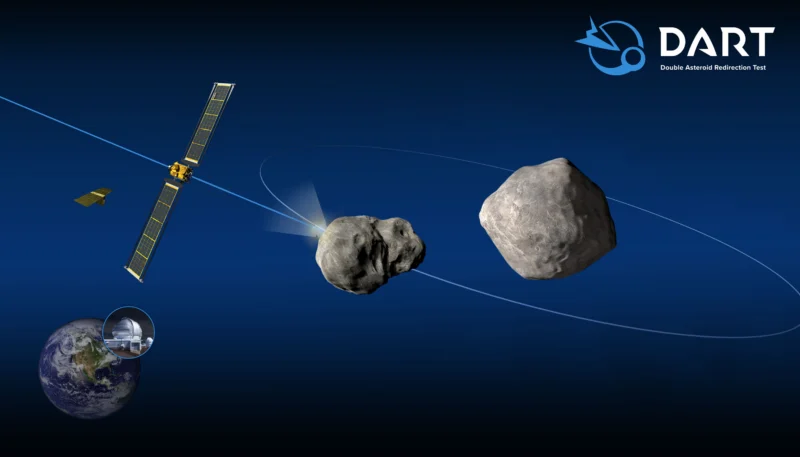
To understand the physics behind the deflection, researchers need to calculate Dimorphos’s mass. Combining that mass figure with the measured shift in its orbit will reveal how efficiently DART transferred momentum to the asteroid. Those calculations will help engineers refine their models and make better predictions for future planetary defense attempts.
What happens next around Didymos
Hera’s flight team plans to guide the probe down to an orbit roughly 13 kilometers from the asteroids in December to take higher-resolution photographs. Navigating that close approach will require extra caution because of the newly discovered boulder field. Michael Kueppers, ESA’s Hera mission scientist, said, “The team will have to take account of these objects in the coming weeks as the mission moves in closer.”
The mission will also release two shoebox-sized CubeSats to gather specialized measurements. The sources give different timelines for the deployment, with The Register reporting it will happen in early 2027, while Engadget reports the release is scheduled for January.
Once deployed, the Italian-led Milani CubeSat will analyze dust and the chemical composition of the asteroid’s surface. The Luxembourg-led Juventas CubeSat will use onboard radar to map the interior structure of Dimorphos before attempting a soft touchdown on the surface.