The leaders of the United States, China and Russia are set to meet Thursday in Shenzhen, facing clashing agendas over Ukraine and nuclear arms.
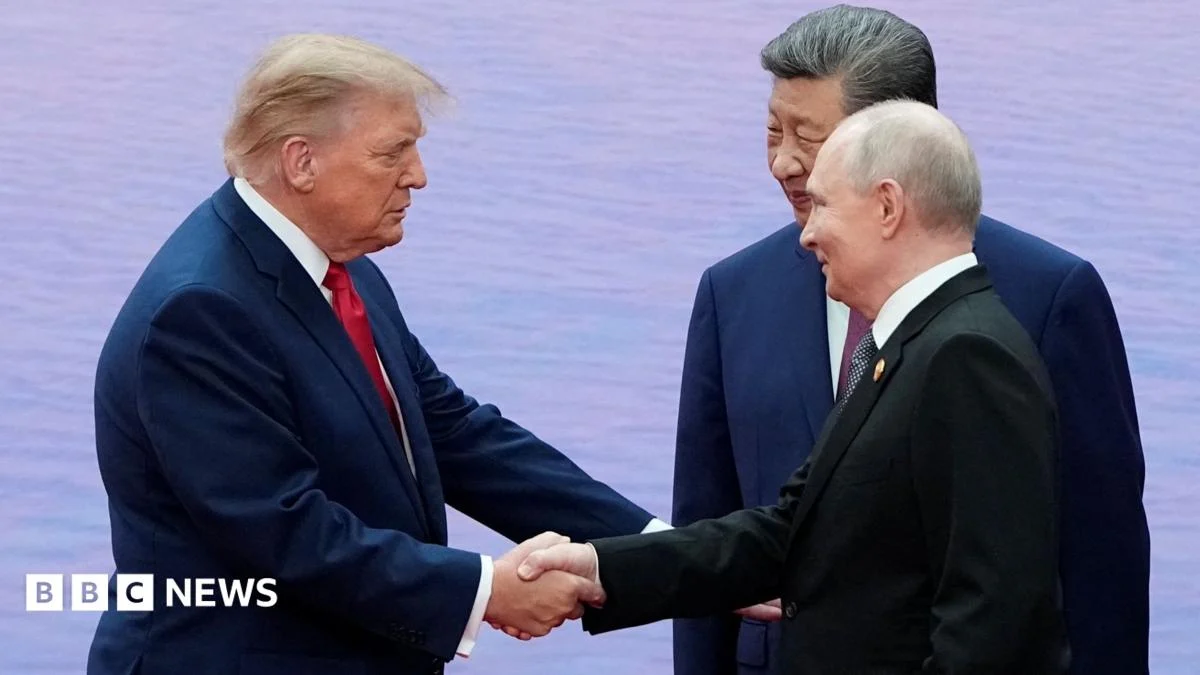
President Donald Trump, Russian President Vladimir Putin and Chinese leader Xi Jinping are scheduled to meet Thursday in the Chinese tech hub of Shenzhen for trilateral talks on the sidelines of the Asia-Pacific Economic Cooperation summit.
The planned gathering comes after the three leaders agreed to hold a three-way summit in China to address weapons controls and trade. Trump oversees the world’s largest economy, Putin commands the largest nuclear arsenal, and Xi leads the largest standing army and manufacturing sector, according to NBC News.
Beijing orchestrated the three-way meeting to bring the rival powers together in Shenzhen, where city streets featured displays of driverless cars, flying drones and dancing robots, BBC News reported. The meeting represents a sharp shift from Washington’s long-standing post-Cold War policy of seeking to drive a wedge between Moscow and Beijing.
Conflicting plans for the Ukraine war
The leaders head into Thursday’s talks with sharply divided priorities over the war in Ukraine, which is now in its fourth year and has killed hundreds of thousands of people. On Monday, Trump announced that he wanted to discuss Ukraine, which he called his favorite subject. That statement contradicted senior White House officials, who said days earlier that the conflict was on a separate track that did not involve China and that discussing it at the trilateral summit would not be appropriate.
Moscow has insisted that Ukraine belong on the agenda, even while Ukrainian officials are absent from the meeting. Both American and Russian officials have suggested that future talks on Europe’s broader security arrangements should be part of a final peace settlement, alarming longtime American allies. Ukrainian President Volodymyr Zelenskyy criticized that direction last month, saying, “we really don’t want this to turn into ‘Yalta 2, 3, 4’ with a redistribution of influence.” The remark pointed back to the 1945 Yalta Conference, where Franklin D. Roosevelt, Winston Churchill and Joseph Stalin met to divide postwar influence.
Xi has resisted placing the war on the summit table. Beijing maintains that it is neutral, urging negotiations while declining to condemn Moscow’s full-scale invasion. Xi faces a delicate balance, as China relies heavily on the European Union as an export market while purchasing Russian oil and gas and seeking to avoid instability in a neighboring partner. Western officials have repeatedly accused Beijing of supporting Moscow’s war effort by supplying components that can be used for military purposes.
Dispute over expanding nuclear arsenals
Trump has stated that he wants the meeting to focus on nuclear disarmament, the war in Iran, economics and trade. He has pushed for a new agreement that limits weapons across all three countries, treating denuclearization as a legacy deal. The last remaining major arms treaty between Washington and Moscow, known as New START, expired in February this year. The end of that pact, which capped deployed warheads, prompted concerns about a renewed arms race.
Securing Beijing’s participation in binding arms caps faces steep resistance. The United States and Russia each hold more than 5,000 nuclear warheads, whereas China possesses an estimated 600 warheads. Although Beijing is expanding its stockpile rapidly, Chinese officials argue that their smaller arsenal makes it unfair to impose the same restrictions that apply to the American and Russian arsenals, maintaining that China should have the freedom to develop its own deterrent.
Domestic pressures and diplomatic stakes for Xi
The meeting gives Xi a visible stage to showcase China as an architect of global affairs rather than a follower of Western policy. The diplomatic event comes ahead of next year’s Communist Party Congress, where Xi is expected to seek a fourth term as party and national leader.
That appearance of global strength comes as China deals with significant economic strain at home. The country is navigating a property slump that has damaged consumer sentiment, high local government debt, cooling factory activity, and a labor market where more workers hold jobs without pensions or social security. Roughly one in five young people in China is struggling to find work.
Chinese foreign policy specialists have downplayed prospects for major breakthroughs, describing the meeting as a starting point to promote stability rather than an occasion for formal treaties. Da Wei, director of the Center for International Security and Strategy at Tsinghua University in Beijing, said in an interview Wednesday that “No matter we like them or not, these three leaders and these three countries are major shapers of the international order.”