

“Did the 2018 ban actually kill it?”
It did not close it. Tumblr still runs, under different ownership, considerably smaller than it was. And the more interesting question is the one underneath: what is a platform once the people who defined it have gone somewhere else?
A scope note before anything else. This page is a history of platform policy and ownership. It does not describe, characterize or discuss the subject matter of the content that was removed, which is not this site’s business and is not necessary to explain what happened.
The sequence
Tumblr was acquired by Yahoo, at a valuation that was much discussed at the time. This page states no figure, because none was confirmed against a primary source for this article and the numbers that circulate are widely repeated and rarely attributed.
In 2018 Tumblr introduced a content policy change that prohibited a category of material which had been permitted, and enforced it with automated detection.
Traffic and activity declined sharply afterwards.
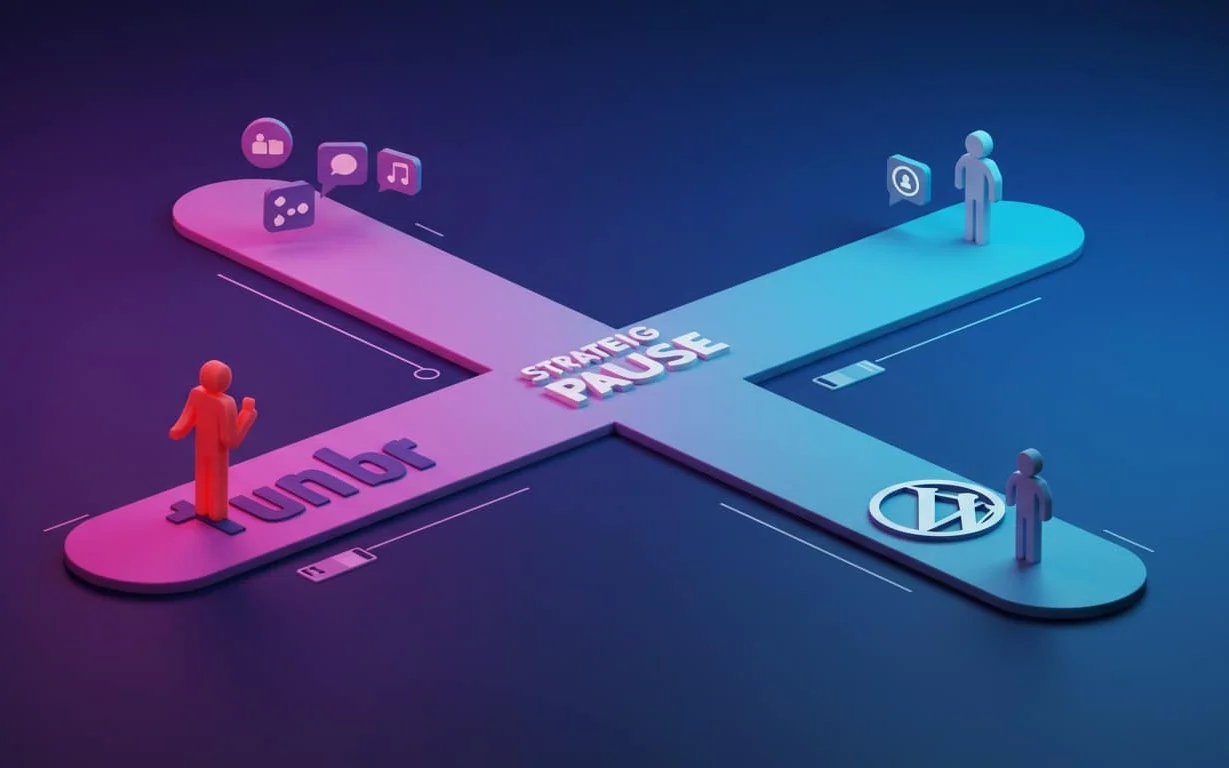
Tumblr was subsequently sold to Automattic, the company behind WordPress.com, reportedly for far less than Yahoo had paid. Again, no figure appears here, for the same reason.
And it continues to run.
The two accounts, and how they fit together
“The ban killed Tumblr” is the popular account, and the traffic decline afterwards is real.
“It was already declining” is the corrective account, and it is also true: the platform’s growth had slowed and its parent company had been struggling with it for some time.
The thing that reconciles them is the same mechanism that runs through this entire cluster.
A platform’s value is the people on it, and specifically the people who make things on it. Tumblr’s distinctive character came from a comparatively small group of highly active creators whose work everybody else was there to see.
A policy change that affects a subset of creators does not lose you that subset. It loses you the people who came for them, and it prompts a broader group of creators to ask whether the platform is a stable place to build anything.
And the automated enforcement mattered independently of the policy. Detection at scale produced a large number of incorrect removals, and a creator whose unrelated work is removed by mistake learns something about the platform that has nothing to do with the policy’s subject.
So: a declining platform can survive a decline. What it cannot easily survive is the people who make the thing deciding at the same time that this is not where they will be.
That is the same shape seen elsewhere in this cluster, where a redesign gave a community of unpaid contributors a reason to leave together at a moment when somewhere else existed.
What survived, and it is more than people assume
The site runs. The archives are up. Blogs from ten years ago are still readable.
That is not nothing, and it is a materially better outcome than most of the services in this cluster. Compare it with what happened to Yahoo Answers, where the content only exists because volunteers saved it before a deadline.
The ownership change is part of why. Automattic’s business is hosting people’s writing, which is a different commercial relationship with a large archive than a conglomerate holding it as one asset among many. A company whose product is keeping text online has a reason to keep text online.
What did not survive is the concentration. The creators dispersed to several other platforms, and the particular cultural output that made Tumblr distinctive is now spread across places that do not resemble it and do not resemble each other.
The structural point worth taking away
Enforcement at scale is a product decision, not an administrative one.

Any platform above a certain size cannot review content by hand, so it detects automatically, and automatic detection has an error rate. The error rate is not a bug in the policy, it is a property of the method, and it lands on people who did nothing wrong.
Which means that when a platform changes what it permits, the visible policy is only half of what changes. The other half is how many people who were never in scope get caught anyway, and what they conclude about the platform afterwards.
That is a durable observation rather than a comment about any one company, and it applies every time any platform changes its rules.
What we are not going to publish
The acquisition value, the sale value, or the difference between them. None confirmed against a primary source for this article.
User or traffic figures before or after the policy change.
The proportion of removals that were incorrect. Widely discussed, not verified.
The subject matter of the removed content. Out of scope by the map’s own rule and unnecessary to explain any of the above.
A verdict on whether the policy was right. This site does not take that kind of position, and the mechanism above holds regardless of what anybody thinks of the rule.
FAQ
Is Tumblr shut down?
No. It still runs, under ownership by Automattic, considerably smaller than it was. Archives from years ago remain readable.
Did the 2018 policy change kill Tumblr?
It did not close it, and the decline afterwards was sharp and real. Growth had already slowed beforehand, so both the popular account and the corrective account are partly right.
Why did the decline happen so fast?
A platform’s value is the people making things on it. A policy change that affects some creators loses you the people who came for them, and automated enforcement at scale removed unrelated work by mistake, which told other creators something about the platform’s stability.
Who owns Tumblr now?
Automattic, the company behind WordPress.com, which acquired it from its previous owner. This page states no sale value because none was confirmed against a primary source.
Are old Tumblr blogs still online?
The site runs and archives remain readable, which is a better outcome than most services in this position get. As with anything hosted by somebody else, a copy of anything that matters is worth having.
This page publishes no acquisition or sale value, no user or traffic figures, and no proportion of incorrect removals, because none was confirmed against a primary source at the time of writing. Dates for the ownership changes are not stated for the same reason and the sequence is described instead.
Per this site’s map, the subject matter of the content affected by the 2018 policy change is not described, characterized or discussed. This is a platform-policy and ownership history.