
Google retired Google Reader on July 1, 2013. It announced the closure on March 13, 2013, in a post called “A second spring of cleaning,” where Reader was the fifth of eight items, and the reason Google gave for closing it was one sentence long.
Thirteen years later people are still annoyed about this, more than about almost any other product shutdown of the era, and the usual explanations are that Google wanted to push Google+ or that RSS was dying anyway. Neither of those is in the announcement. What is in the announcement is more interesting, and it is still readable at its original address on Google’s own blog, which is not something that can be said of most of the shutdown notices from that period.
What the announcement actually said
The post was written by Urs Hölzle, described on it as SVP Technical Infrastructure and Google Fellow, and dated March 13, 2013. Its framing sentence is about focus: to make the most of the opportunities in front of the company, Hölzle wrote, “we need to focus,” because otherwise Google would spread itself too thin and lack impact.
On Reader specifically:
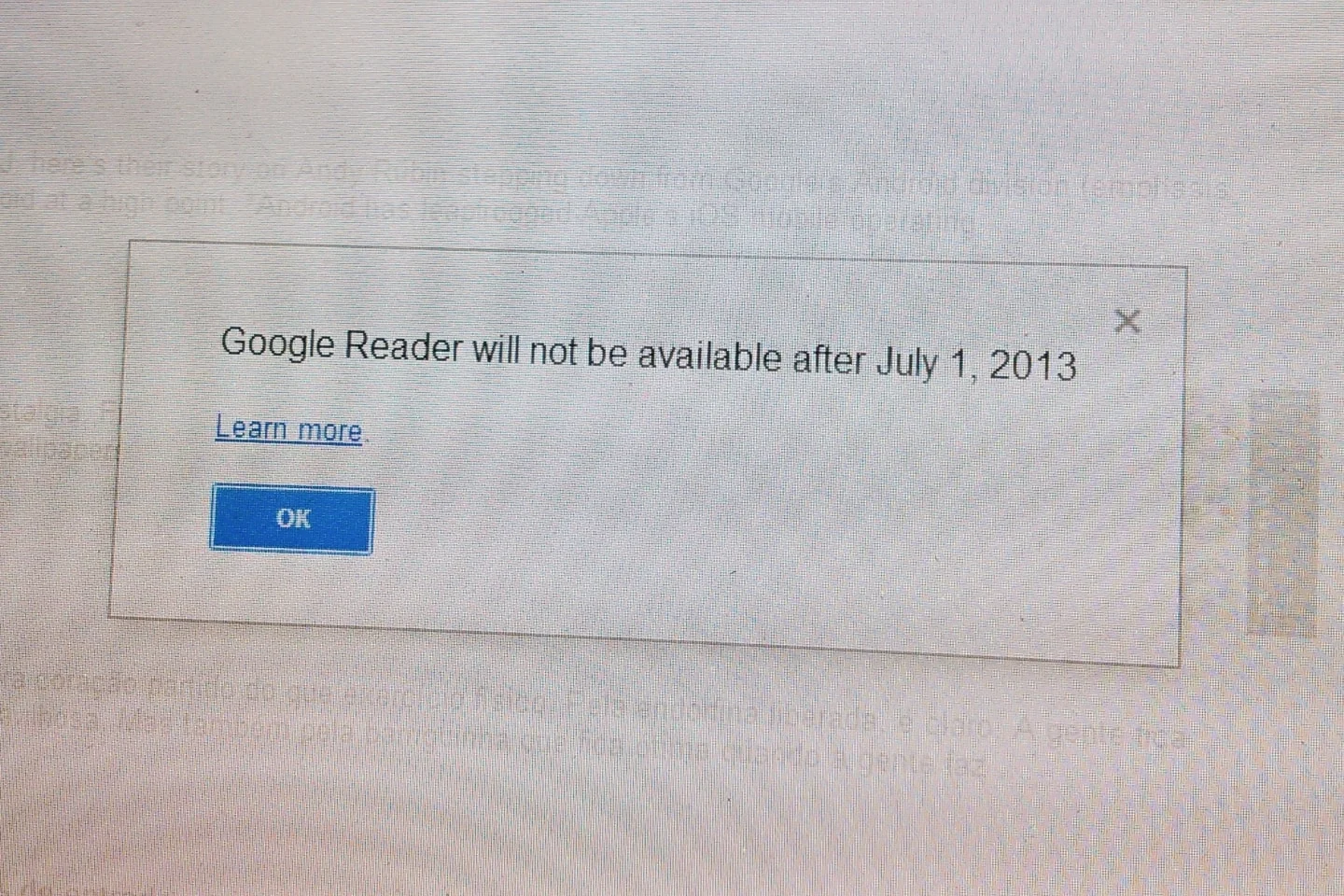
“on July 1, 2013, we will retire Google Reader”
And the whole of the reason:
“While the product has a loyal following, over the years usage has declined.”
That is it. No figure, no chart, no comparison, no mention of any other Google product it was being folded into. Every account you have read that explains the closure in terms of a strategy, a rivalry or an internal politics is explaining something Google did not say. Some of those accounts may well be right. None of them is quoting this post, because there is nothing in it to quote.
The part almost nobody mentions: it was item five of eight
Reader was not the subject of the announcement. It was one entry in a list. The same post retired or wound down, in its own words:
- The Apps Script GUI Builder and five UiApp widgets, available until September 16, 2013
- The CalDAV API, restricted to whitelisted developers and shut down for others on September 16, 2013
- Google Building Maker, retired June 1, 2013
- Google Cloud Connect, the plug-in for syncing Microsoft Office files, ending April 30, 2013
- Google Reader, retiring July 1, 2013
- The Google Voice app for BlackBerry, support ending the week after the post
- The Search API for Shopping, shutting down September 16, 2013
- Snapseed Desktop for Macintosh and Windows, no longer sold or updated
Read that list and the shape of the decision becomes visible. This was a developer-facing housekeeping post, and Reader sits in it between a phone app for a dying handset platform and a shopping API. It is the only consumer product in the group with a substantial and vocal following, and it was announced in the same register as a deprecated widget set.
That is the closest thing to an answer to “why are people still angry”. Not because a product ended. Because of where the notice was filed.
What “export your data” actually meant here
The post’s instruction to users was:
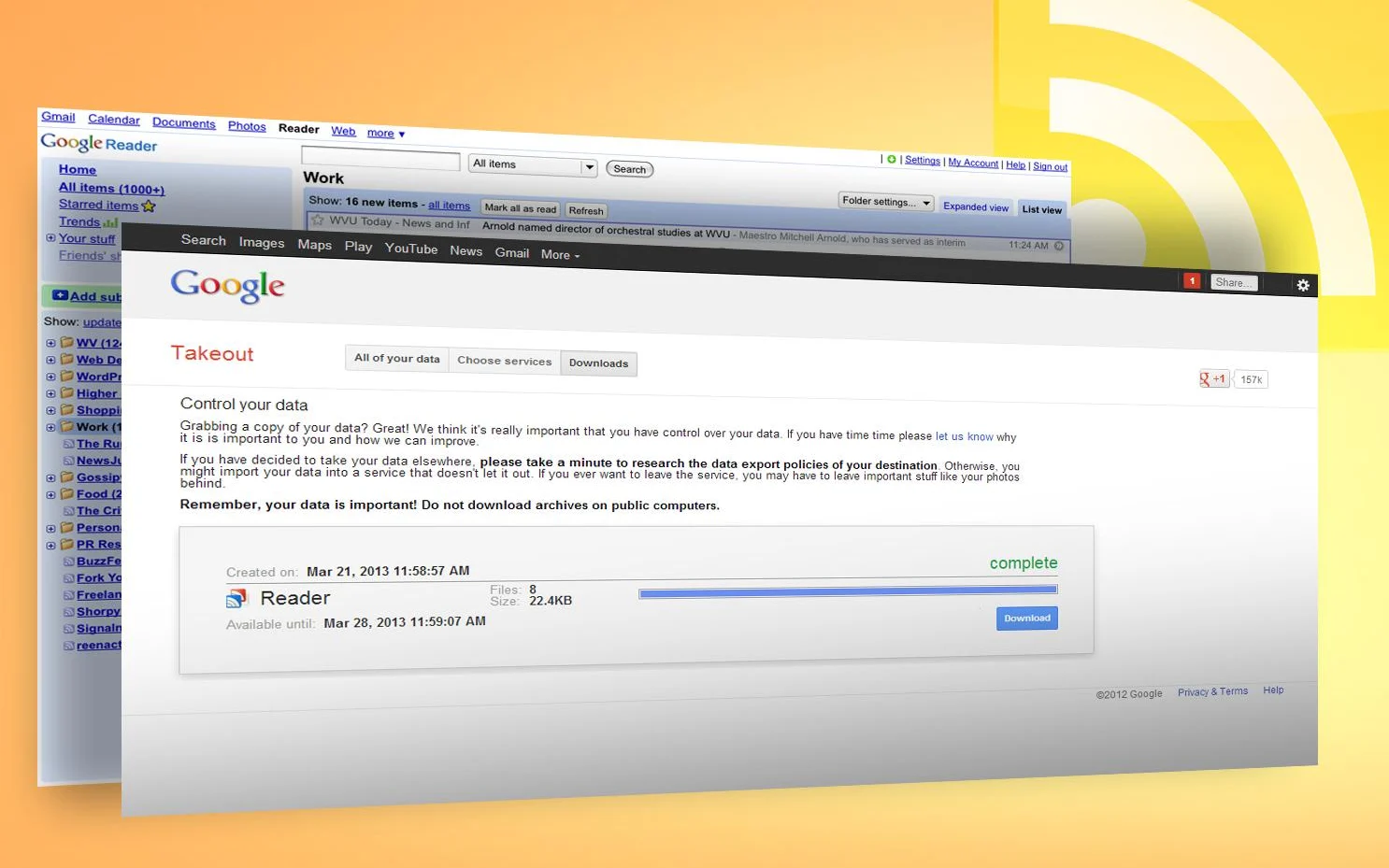
“Users and developers interested in RSS alternatives can export their data, including their subscriptions, with Google Takeout over the course of the next four months.”
This is where Reader is genuinely different from almost every other shutdown covered on this site, and it is worth being precise about it.
Reader was not holding anyone’s content. The articles inside it belonged to the publications that wrote them, and they arrived through feeds published at the publishers’ own addresses. What Google held was a list of those addresses, per user, plus reading state.
A subscription list is a file. It is small, it is a standard format, and it points at resources that continue to exist without Google. So when Google said users could export their subscriptions, the thing exported was genuinely the valuable part, and a reader who took the export could load it into something else and carry on. This is the rarest outcome in this whole category: a shutdown where the data really was portable, because the platform had never owned it in the first place.
Compare that with the platforms whose entire value was the content users had uploaded into them, where an export offer is a much thinner promise, and where what a person can read today was often saved by volunteers rather than by the company. Reader needed no rescue archive, because there was nothing in it to rescue.
So what was actually lost
Three things, none of which had a file format.
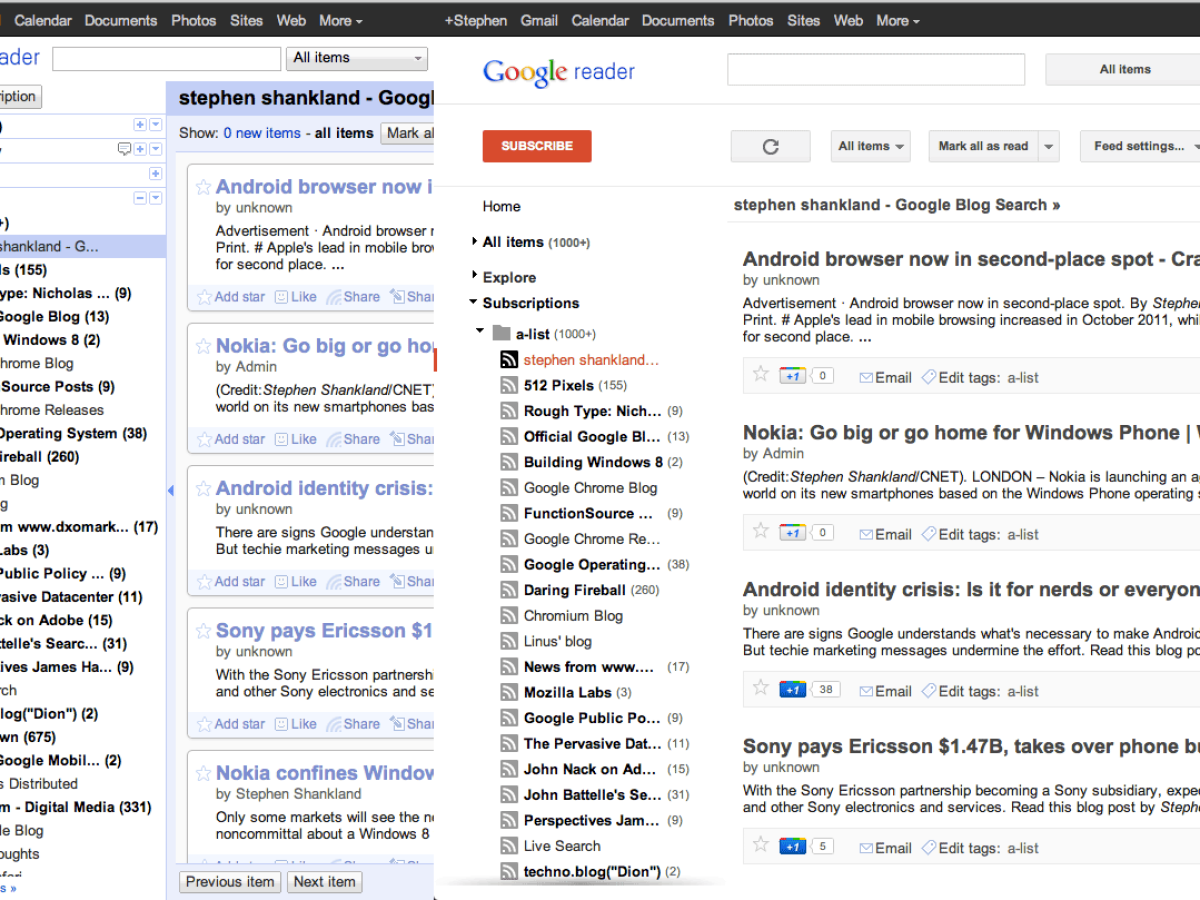
The default. Reader was, for practical purposes, where RSS happened. A very large share of the people who read feeds read them there, and a large share of the tools that handled feeds handled them by talking to Reader. Closing it did not delete anyone’s subscriptions. It removed the place everyone had agreed to meet, and it did so for the ecosystem all at once.
The reading state. Which of several thousand items you had already seen, across devices, is exactly the kind of thing that makes a reading tool usable and exactly the kind of thing that does not survive a move.
The social layer. Reader had a sharing and commenting function that a particular community used heavily and cared about a great deal, and communities do not export.
The subscription list, the one thing Takeout could hand back, was the cheapest of the four to replace.
What replaced it, and what that says
Within months of the announcement, other feed readers added the ability to import a Google Takeout subscription file, and RSS carried on in a smaller and more fragmented way rather than ending. We are naming none of them here, because we did not read their announcements at source and this site does not repeat product claims it has not checked. What matters for the history is the structural point: the format outlived the product, because the format was never Google’s.
That is not the usual ending. On this site the usual ending is that a company promised an archive, did not keep it, and what a reader can reach today was preserved by volunteers. Reader’s ending is the exception, and the exception is instructive: the shutdowns that hurt least are the ones where the platform was a lens rather than a container.
Where a platform was a container, the outcome is different and much worse. When Pebble’s servers went dark, the watches on people’s wrists needed somebody to keep the infrastructure alive, and what happened next was a volunteer project rather than a company. Nothing like that was needed for Reader, and that difference is the whole lesson.
Why the anger is not really about RSS
The last thing worth saying is about the tone of the reaction, which was disproportionate to what a feed reader is, and which has not faded the way most of these do.
Reader’s users were, disproportionately, people who read a great deal, professionally or obsessively, and who had built a daily routine around a free product from a company that gave every impression of intending to keep it. The closure taught a generation of heavy users that “Google runs it” was not the same as “it will be there,” and that lesson landed on people whose job was to write on the internet. That is why the shutdown got, and keeps getting, more coverage than its size warrants: the people most affected were the people with the most keyboards.
Google has closed a great many things before and since, some of them far more expensive and far more publicized, including the hardware experiment it spent years defending. Reader remains the one that gets brought up.
The dates, in one place
| Date | What happened |
|---|---|
| 2005 | Google Reader launched, described in the announcement post as an RSS feed service launched in 2005 |
| March 13, 2013 | Retirement announced in “A second spring of cleaning,” as item five of eight |
| March to July 2013 | Google Takeout export window, described in the post as “the next four months” |
| July 1, 2013 | Google Reader retired |
What this page does not claim
- No user numbers. Google published none in the announcement, and we found no figure attributable to Google. The counts that circulate are not repeated here.
- No internal motive. The strategic explanations that dominate this search are absent from the primary document, and we are not going to assert them.
- No named successor product. See above.
- No buying advice. This site writes what happened, not how to avoid it happening to you.
Sources. Every quotation, date and list item on this page is taken from Google’s own post “A second spring of cleaning,” published on Google’s blog on March 13, 2013 and attributed to Urs Hölzle, SVP Technical Infrastructure and Google Fellow, read in full at blog.google on August 26, 2026. Where this page describes what was lost rather than what was announced, it says so, and it names no figure it could not source.