
Short answer: Google Glass ended twice. The consumer version, sold to testers as the Explorer Edition from 2013 at $1,500, was pulled in January 2015 after a backlash that was more social than technical. Glass then had a second life as a workplace device: Glass Enterprise Edition launched in 2017 and Enterprise Edition 2 in 2019, both sold to factories, warehouses and hospitals rather than to the public. Google stopped selling that version on March 15, 2023 and ended support on September 15, 2023. That second date is the real end of Google Glass, and most retrospectives skip it entirely.
So the common summary, that Glass was a 2015 flop, is about eight years short.
What Google Glass actually was
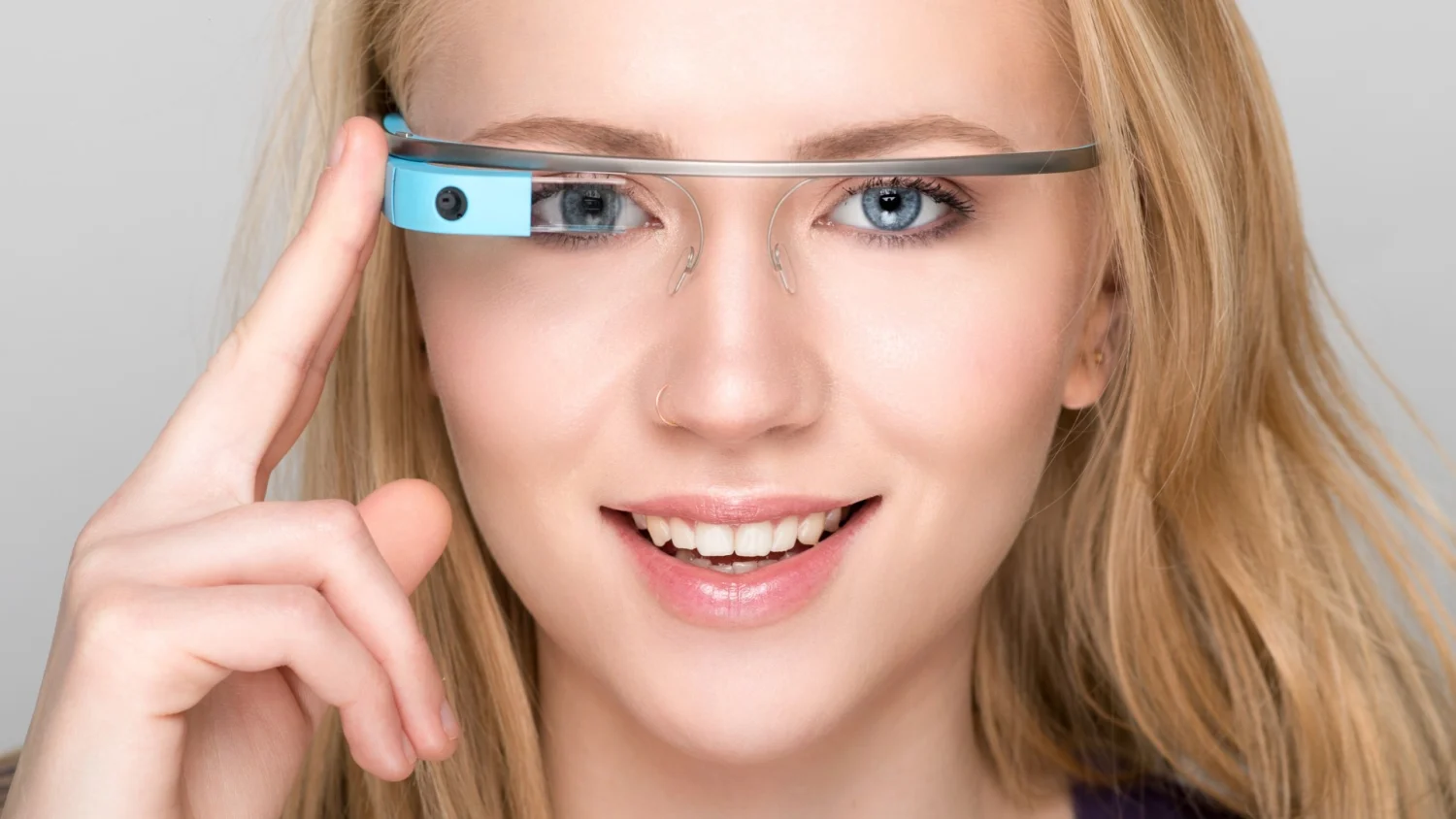
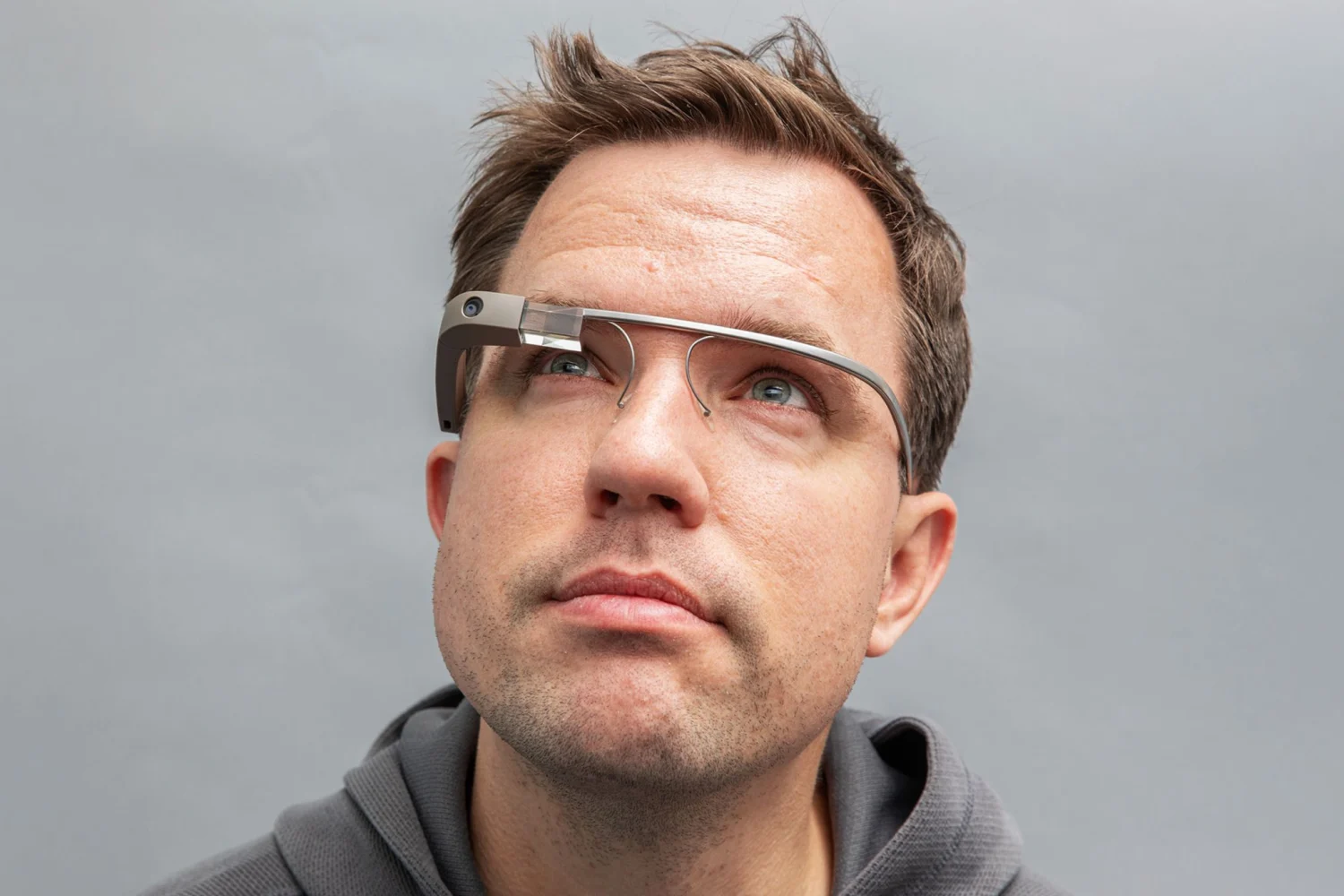
Glass was a small computer built into a spectacle frame. On the right-hand side sat a prism that projected a tiny display into the wearer’s field of view, positioned above the line of sight so you glanced up at it rather than through it. Alongside it were a camera, a touch-sensitive strip on the temple arm, a microphone and a bone-conduction speaker that vibrated sound into the skull rather than into the ear.
You spoke to it. The phrase “OK Glass” started a command, and it would take a photo, record video, give directions, translate a sign or read out a message. It paired with a phone for its data connection.
The thing to hold on to is that Glass was not a virtual reality headset and it was not trying to be. It did not replace what you were looking at. It put a small amount of information beside it, which is a much more modest idea than the one it usually gets remembered as.
2012 to 2014: the Explorer program
Google announced the project publicly in April 2012 and demonstrated it at its developer conference that June in a stunt involving skydivers wearing Glass, which is worth mentioning only because it set the tone for how the product was introduced. It arrived as a spectacle rather than as a tool.
In 2013 Google began selling the Explorer Edition to a selected group of developers and enthusiasts at $1,500. In 2014 it opened sales more widely in the United States and the United Kingdom, still at that price and still labeled as an early prototype rather than a finished product.
The Explorer program was a genuinely unusual approach: put an unfinished device in public and find out what happens. What happened was informative and mostly not what Google expected.
Why the consumer version failed, in three parts
These get compressed into one sentence in most retellings. They were three different problems, and only one of them was actually fatal.
The price. At $1,500, Glass cost more than a laptop and did less than a phone. That alone limited it to people buying it as an experiment.
The product. It was an early prototype and behaved like one. Battery life was short, particularly when recording video. The display was small and hard to read in bright light. The list of things it could usefully do was shorter than the demonstrations implied. None of this was disqualifying on its own, because first versions of things are usually poor and get better.
The camera pointing at everyone else. This was the fatal one, and it was not a technical problem at all. Glass put a camera on a person’s face, aimed at whoever they were talking to, with no obvious way for that person to know whether it was recording. The objection did not come from buyers. It came from everybody else in the room.
The consequences were concrete rather than abstract. Bars, restaurants, cinemas, casinos, hospitals and locker rooms banned the device. A vocabulary of insult grew up around people who wore one in public. Legislators in several jurisdictions raised questions about recording in private spaces. Google published etiquette guidance, which is not something a company does about a product that is going well.
The lesson that Glass actually taught is narrow and specific: a wearable computer is a social object, and it has to be acceptable to the people around the wearer, not only to the person who bought it.
January 2015: the first ending
Google stopped selling the Explorer Edition in January 2015 and closed the Explorer program. The project moved out of the Google X research division and into a separate team, and public communication about it largely stopped.
This is where most accounts of Glass finish, and it is why the device is remembered as a short, expensive embarrassment. It was neither short nor finished.
2017 to 2023: the enterprise second life
In July 2017 Google reintroduced Glass as Glass Enterprise Edition, and this time did not sell it to the public at all. It went to businesses through a small set of authorized partners, aimed at people doing work with their hands.
The use case was genuinely sensible, and it is the opposite of the consumer pitch. A technician assembling a wiring harness, a warehouse worker picking orders, a field engineer following a service procedure: all of them need instructions in front of them and both hands free. A small display above the eye line does that job well, and in a factory the camera raises far fewer objections than it does in a bar, because everyone present is an employee working under a policy.
Google shipped Glass Enterprise Edition 2 in May 2019, built on a newer processor with better battery life and a design that could be fitted to safety frames. It sold quietly for four years, which is longer than the consumer version lasted by a wide margin.
March 2023: the actual ending
On March 15, 2023, Google stopped selling Glass Enterprise Edition 2. Its support notice set out what that meant: no further software updates, replacement devices available only until September 15, 2023, and after that date the existing headsets would keep working with the software already on them, while services guaranteed only to that date could stop functioning.
That is the ordinary shape of a hardware wind-down. The device does not switch off. The support around it stops, and what the device can reach slowly narrows. The same pattern appears across this cluster, including in what happened to Pebble, where the company’s servers going dark mattered far more to owners than the hardware itself ever did.
Where the technology went
Glass ended. Almost nothing that Glass contained did.
The head-worn display survived and spread. Enterprise headsets from other manufacturers picked up the assisted-work use case Glass had proved. Consumer smart glasses came back later in a deliberately reduced form, dropping the projected display in favor of audio and a camera, which is a direct response to the two things that sank Glass: the display was expensive and hard, and the camera was the part people objected to.
Voice assistants went from novel to ordinary. Live visual translation, one of Glass’s more impressive demonstrations, is now a phone feature. The bone-conduction speaker turns up in headphones. None of this required Glass to succeed; it required Glass to demonstrate the idea in public and take the criticism.
The failure that has not been solved is the social one. Every subsequent attempt at putting an outward-facing camera on a face has run into the same objection from the same people, which is everyone who did not buy it.
Was it a failure, or was it early?
Both framings are used and both are a little wrong.
Calling it early implies the market simply had to catch up, and that is not what happened. The consumer objection to Glass was not unfamiliarity. It was a reasonable complaint about being recorded, and it has not faded with time.
Calling it a failure ignores six years of enterprise sales and the fact that Google shipped a second generation of a product it supposedly abandoned in 2015. Products that fail outright do not get a second generation four years later.
The accurate description is narrower. Glass was a correct read on where the display should go and a wrong read on where the camera could go. The half that worked continued in the setting where the objection did not apply, which was work, and it ran there until 2023.
That pattern, where a category dies because using it in front of other people is uncomfortable rather than because the engineering was bad, appears again in why 3D TVs failed, which asked far less of its buyers and still lost. And the separate problem of a platform that never attracted enough developers to be worth owning is set out in what happened to Windows Phone.
The full index of devices in this cluster, grouped by what actually ended each one, is at the dead gadgets of the 2000s and 2010s.
A note on the numbers of Google Glass
Google never published sales figures for Glass in either its consumer or its enterprise form. Every unit number you will see attached to it is an outside estimate, and the estimates vary by orders of magnitude. This article uses the dates and the actions, both of which Google documented, and leaves the sales totals alone.