
Short answer: Pebble was the smartwatch that started it all. In 2012 it broke Kickstarter’s funding record, sold millions of watches known for their always-on e-paper screens and week-long battery life, and built a passionate developer community. It never turned that head start into a lasting business, ran low on cash as Apple and Google moved in, and sold its software and team to Fitbit in December 2016. Volunteers at a project called Rebble kept the old watches running after the servers went dark in 2018. Then came the twist: in 2025, Google open-sourced Pebble’s operating system and founder Eric Migicovsky brought Pebble back.
That is the whole arc in one paragraph. Below is the full story, told by a site that was covering Pebble’s pre-orders as they happened in 2012.
Pebble in 90 seconds
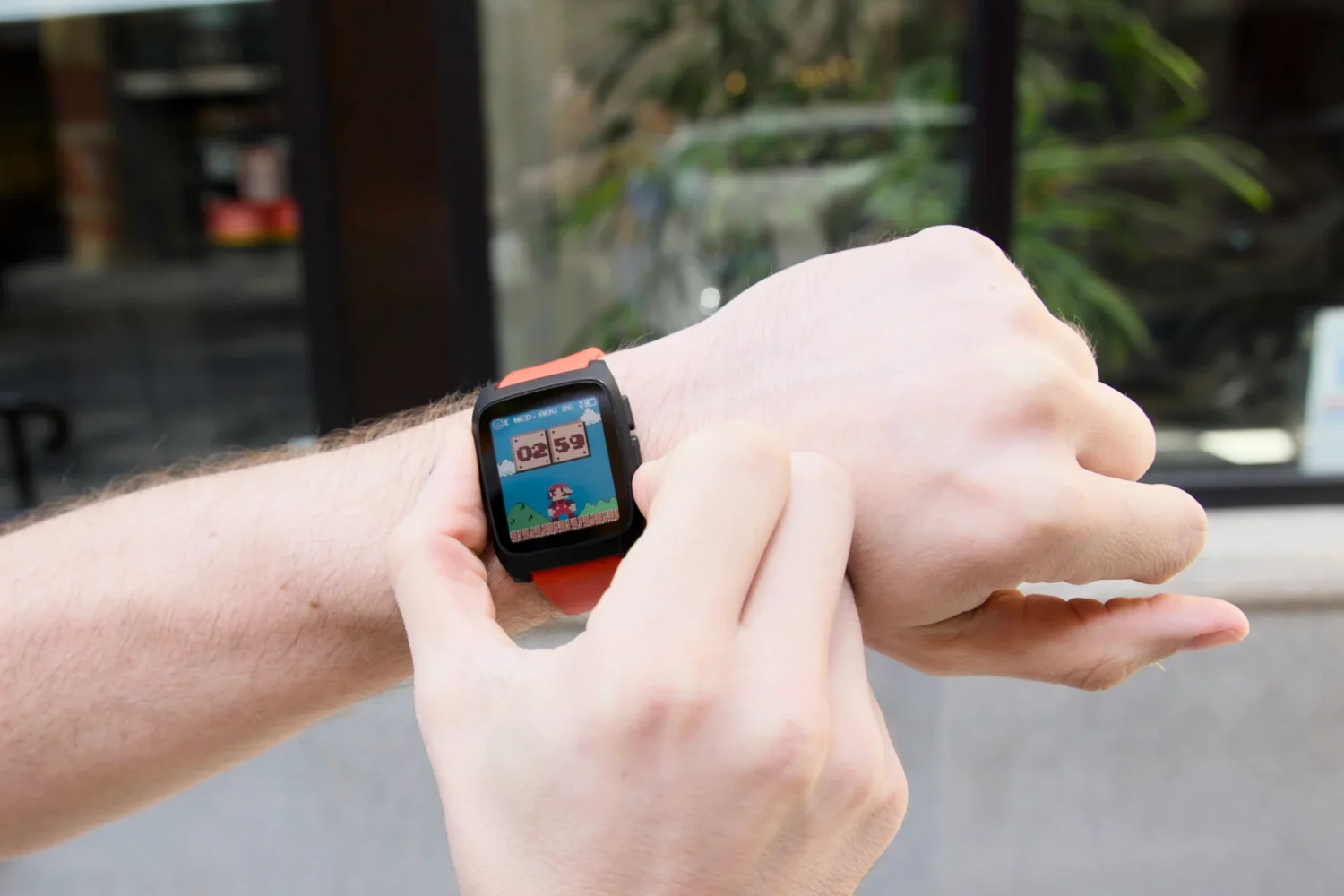
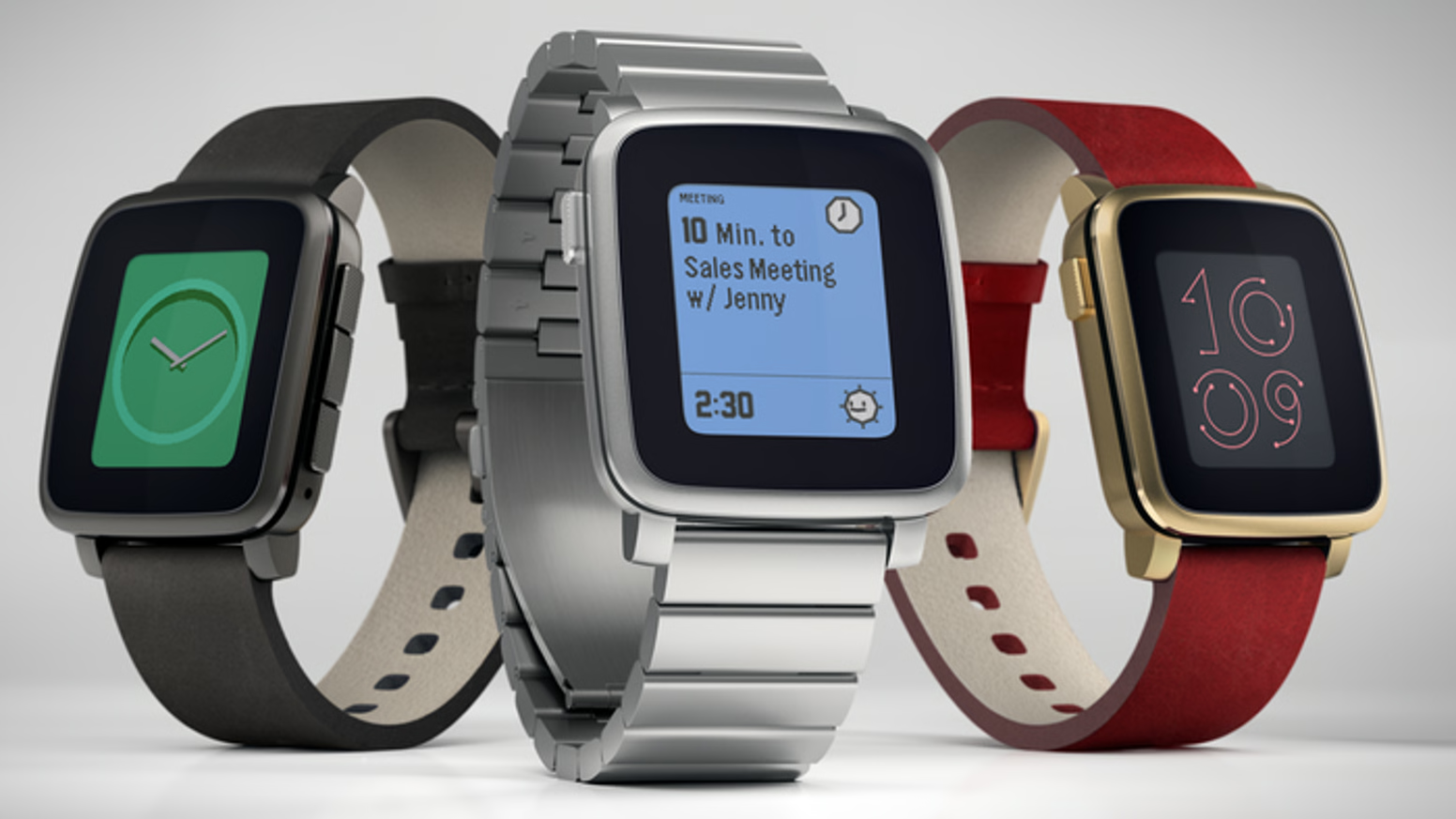
Pebble made a wristwatch that connected to your phone over Bluetooth and showed your notifications, controlled your music, and ran small apps and custom watchfaces. Its signature feature was a black-and-white e-paper display that stayed on all the time and sipped so little power that a charge lasted about a week, not a day. It launched years before the Apple Watch existed. It died as an independent company in 2016. As of 2026, it is alive again under its original name, with new watches and fully open-source software.
2012: The Kickstarter that broke records
Pebble did not start with a factory or a big investor. It started with a Kickstarter campaign in April 2012, and it caught fire almost instantly. We wrote about the pre-order rush at the time in our original 2012 post, Pebble SmartWatch Preorder for iPhone and Android, when the project hit its first $100,000 within about two hours of going live.
It did not stop there. By the time the campaign closed, Pebble had raised roughly $10.3 million from 68,929 backers, which made it the most-funded project in Kickstarter’s history up to that point. That single campaign did two things. It proved that ordinary people wanted a smartwatch before any tech giant had shipped one, and it turned Pebble into a symbol of what crowdfunding could do.
Fans loved Pebble for reasons that still sound modern. The screen was readable in direct sunlight. The battery lasted about a week. It worked with both iPhone and Android. And Pebble handed developers a real software kit, so an entire community grew up building watchfaces and apps that Pebble itself never had to make.
2013 to 2015: The best years, and the first cracks
The follow-up years were Pebble’s peak. The company shipped refined models, including the metal Pebble Steel and, in 2015, the color e-paper Pebble Time. That 2015 model returned to Kickstarter and broke records again, pulling in more than $20 million and reminding everyone how loyal the fanbase was.
But the ground was shifting underneath Pebble. Google’s Android Wear platform arrived in 2014, and Apple shipped the Apple Watch in April 2015. Pebble had invented the category and then found itself competing against the two largest companies in consumer technology, both of which could pour in money, retail space, and marketing that a startup simply could not match. Pebble’s answer, longer battery life and simplicity, was real, but it was a harder story to sell against glossy touchscreens.
2016: Why Pebble really failed
The honest version of Pebble’s failure is not that the product was bad. It is that the company ran out of runway in a race against giants. Founder Eric Migicovsky later wrote his own postmortem about the final stretch, describing a cash crunch, tightening funding, and the brutal math of hardware, where you spend money to build inventory long before customers pay you back.
Competition made every mistake more expensive. When you are the small company that created a market, the big companies do not have to beat you on quality. They only have to be good enough while outspending you until your money runs out. That is roughly what happened.
The Fitbit sale and what owners lost
In December 2016, Fitbit acquired Pebble’s software, key intellectual property, and much of its team. Fitbit’s own financial filings later put the deal at around $23 million, well below the up to $40 million some early news reports cited at the time. Either way, this was an asset sale, not a rescue of the product.
Pebble the hardware brand stopped. New watches were cancelled, warranties and support wound down, and existing owners were told the online services their watches relied on would eventually be switched off. Because a Pebble leaned on Pebble’s servers for things like the app store, voice dictation, and timeline features, “switching off the servers” meant millions of working watches were on a countdown to becoming far less useful.
2018 to 2024: Rebble, the community that refused to let it die
This is where the Pebble story stops being a normal corporate obituary. A group of fans, independent developers, and former Pebble employees formed a project called Rebble and set out to replace the servers themselves.
Fitbit originally planned to pull Pebble’s web services and later set the final date for June 30, 2018. Ahead of that deadline, Rebble launched Rebble Web Services, a community-run replacement for the online features Pebble owners were about to lose. Former Pebble engineer Katharine Berry used her knowledge of the original server setup to help rebuild the pieces, and owners could switch their watch over to Rebble’s system to keep using it.
For years after the company was gone, that is what kept Pebbles ticking. Not a corporation, but volunteers who cared enough to reverse-engineer and maintain an ecosystem the market had abandoned.
2025 and 2026: Google opens PebbleOS and the founder returns
Here is the twist almost no one saw coming.
In January 2025, Google, which by then owned Fitbit, open-sourced PebbleOS, releasing the watch operating system’s source code publicly. That single decision removed the biggest barrier to a real revival: the software was now legally available for anyone to build on.
Eric Migicovsky, Pebble’s original founder, moved quickly. In early 2025 he started a new company, Core Devices, to build new watches running the open-source PebbleOS. Core Devices announced two models, initially called the Core 2 Duo, with a small monochrome e-paper screen and battery life quoted at over 30 days, and the Core Time 2, with a larger 64-color e-paper touchscreen.
In mid-2025, the story got even better for old fans: Migicovsky recovered the Pebble trademark, and the watches took the original name back. The Core 2 Duo became the Pebble 2 Duo and the Core Time 2 became the Pebble Time 2. By late 2025, the team reported that Pebble’s software stack had become fully open source, a deliberate move so the watches can never again be stranded by one company pulling the plug. Going into 2026, the project was still expanding, with a new model shown publicly and pre-orders reported in the tens of thousands.
It was not entirely smooth. As the revival grew, tension surfaced between Migicovsky and the Rebble community, including public disagreement over data and server access. That friction is worth naming honestly, because the community that kept Pebble alive and the founder who is rebuilding it do not always see eye to eye.
Can you still use an original Pebble today?
Yes, in many cases. Thanks to Rebble Web Services, a lot of original Pebble watches from the 2012 to 2016 era can still connect, show notifications, and run apps and watchfaces, as long as you set them up with the community services rather than the long-dead official ones. It is not guaranteed for every scenario, and some features depend on your phone and setup, but “my old Pebble is a paperweight” is not automatically true. That afterlife is one of the most unusual things about Pebble, and it is a big reason the brand still has such a devoted following.
Where Pebble stands as of 2026
Pebble is one of the very few dead gadgets to get a genuine second life. It pioneered the smartwatch, lost the funding race to Apple and Google, and was sold for parts in 2016. Then its community kept it running, its old owner open-sourced the code, and its founder brought it back under its real name with new hardware and a promise to keep the software open. It is a rare happy ending in consumer tech, though it comes with real questions about whether a small, principled company can survive against giants any better the second time than it did the first.
Frequently asked questions
What happened to the Pebble smartwatch?
Pebble pioneered the smartwatch through a record-setting 2012 Kickstarter, sold millions of watches, then ran short on cash and sold its software and team to Fitbit in December 2016. The community kept old watches alive through the Rebble project, and in 2025 the founder revived Pebble after Google open-sourced its operating system.
Who bought Pebble and for how much?
Fitbit acquired Pebble’s software, intellectual property, and much of its team in December 2016. Fitbit’s own filings later reported the deal at around $23 million, lower than the up to $40 million cited in some early news coverage.
Is Pebble coming back in 2026?
Yes. Founder Eric Migicovsky started a new company, Core Devices, in 2025 to build new watches on the open-sourced PebbleOS. He recovered the Pebble trademark in mid-2025, so the new models carry the Pebble name again, and the project continued shipping and expanding into 2026.
Do old Pebble watches still work?
Many do. The volunteer-run Rebble Web Services replaced Pebble’s shut-down servers in 2018, so a lot of original watches can still handle notifications, apps, and watchfaces if you connect them to the community services instead of the discontinued official ones.
Why did Pebble fail if people loved it?
It was not a product problem. Pebble created the smartwatch market and then had to compete against Apple and Google, who could outspend a startup indefinitely. Hardware also ties up cash long before customers pay it back, and Pebble ran out of runway.