
“Nothing has replaced that random button.”
That is the most common sentence people write about StumbleUpon, and it is close to true. Something did replace it structurally. What replaced it is a different kind of thing, and the difference is the article.
What it actually did
A button in your browser toolbar. You pressed it, and a page appeared that you had not asked for.
Two things about that are worth naming precisely, because they are the parts nothing has reproduced.
You did not choose. No search box, no feed, no list of options. The absence of a decision was the product.
It sent you off the site. StumbleUpon’s entire function was to deliver you to somebody else’s webpage and get out of the way. It made no attempt to keep you.
Both of those are now unusual to the point of being extinct, and that is not a coincidence.
Why nothing replaced it, and the reason is commercial
Modern recommendation systems do the same computation and reach the opposite conclusion about where to send you.
A feed recommends things inside itself. A video platform recommends the next video on the same platform. A social network suggests content from its own users. Every one of them is optimized to keep you there, because time on the platform is what the platform sells.
StumbleUpon’s model was to send you away, which meant its value to a user was inversely related to its ability to monetize attention. A product whose success is measured in how quickly you leave is a product with a difficult business model, and that is the honest answer to why nothing has replaced it.
Not that it could not be built. That there is no reason for anyone to build it.
The other half: what it did to the open web
StumbleUpon was, for a period, a substantial source of traffic to small independent websites.
A person running a personal site could receive a large number of visitors from a source that had no relationship with them, had not been paid, and had chosen them because a stranger had liked the page.
That route does not really exist any more. Discovery now runs through search, through platform feeds, and through algorithmic recommendation inside walled products. All three of those favor scale, and none of them has an equivalent of a stranger pressing a button and landing on a page made by one person.
This is a real loss and it is worth naming without romanticizing it. Plenty of what the button delivered was junk. What it also delivered was a route to an audience that did not require you to be optimized for anything, and that route is what closed.
What happened to the service
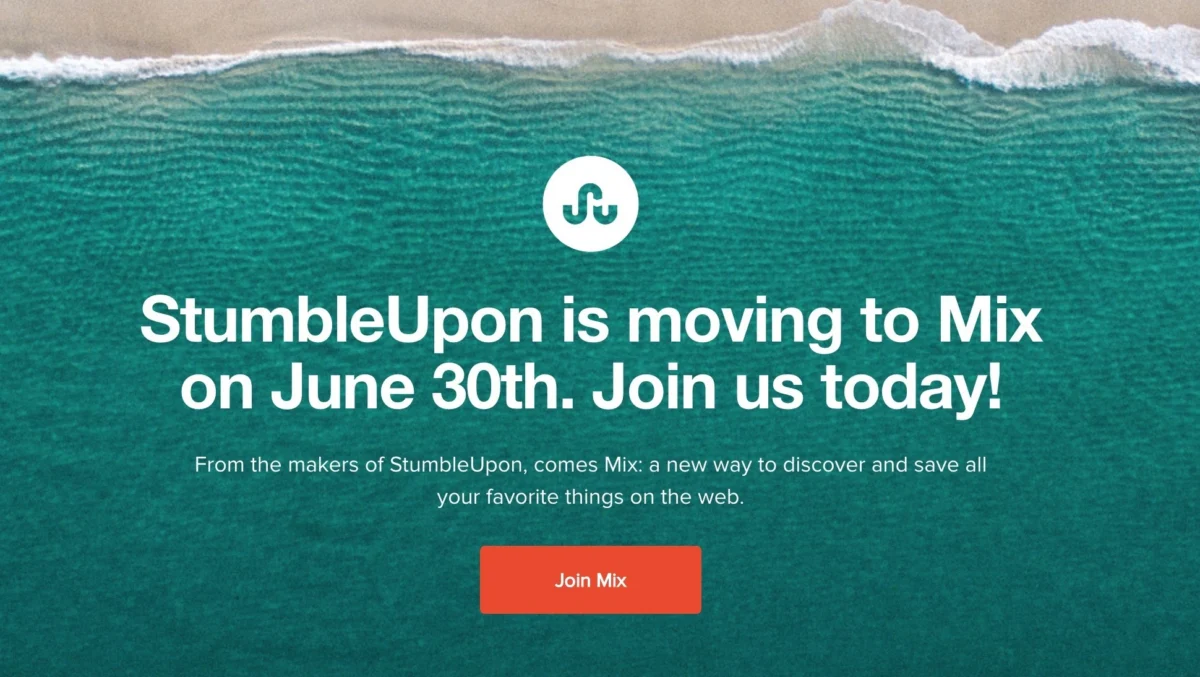
StumbleUpon closed, and its founder launched a successor service, Mix, to which accounts and saved pages could be migrated.
Mix is a different product. It is closer to a curation and saving service than to the button. Which is consistent with everything above: the part that was hard to sustain was the part that sent you away, and the part that survived is the part that keeps something.
We are not going to state the closure date, because it was not confirmed against a primary source for this page, and dates on this subject are widely repeated and rarely attributed.
Where the behavior went instead
The impulse StumbleUpon served, “show me something, I do not care what”, did not disappear. It moved.
It went into infinite scrolling feeds, which serve the same impulse with a fundamental difference: the feed decides what to show you based on what keeps you scrolling, rather than based on what somebody else liked.
That is the substitution, and it is not equivalent. One optimizes for your engagement with the platform. The other optimized for your engagement with somebody else’s page.
The same tension runs through several stories in this cluster. It appears in what happened to Google Reader, where a tool that sent people to other people’s websites was ended by a company whose interests lay in keeping them, and it is why people are still annoyed about that one more than a decade later.
What survived
The saved pages, for people who migrated them.
Very little else, and this is one of the cases where the thing lost is not content but a behavior. You cannot archive a button.
What did survive is the demonstration that people will accept a recommendation without choosing, which every algorithmic feed now relies on. As with several stories in this cluster, the product died and the idea won, and the same shape appears in what happened to Vine.
What we are not going to publish
User counts or traffic figures. None verified.
Funding or acquisition values.
The closure date, not confirmed against a primary source at the time of writing.
A claim that the modern web is worse. It is different in a specific, describable way, and describing the way is more useful than a verdict.
FAQ
Why did StumbleUpon shut down?
Its function was to send users off the site to somebody else’s page, which is a hard model to monetize in an economy built on retaining attention. It closed and its founder launched a successor service, Mix, to which accounts could be migrated.
Is there a StumbleUpon replacement?
Mix is the direct successor from the same founder, and it is a curation and saving service rather than the button. Structurally, algorithmic feeds serve the same impulse, but they recommend content inside their own platform rather than sending you away.
Why does nothing work like it any more?
Because a product measured by how quickly you leave is difficult to build a business on. Modern recommendation systems do a similar computation and are optimized to keep you where you are.
Did StumbleUpon send a lot of traffic to small sites?
It was, for a period, a substantial source of visitors to independent websites, delivered without any commercial relationship. That route to an audience is largely gone.
Can I still get my saved pages?
Accounts and saved pages could be migrated to the successor service at the time of the closure. Anything not migrated is in the same position as content on any closed service.
This page publishes no user-count figure, traffic figure, funding value or acquisition value. Where a specific date could not be confirmed against a primary source at the time of writing, no date is stated.