

Almost none of these platforms died because the software stopped working. They died because someone bought them, or replaced them, or redesigned them, or because the thing they were built on top of was switched off. The technology was rarely the problem.
That matters, because the usual story about the old web is a story about progress: better products replaced worse ones, and that is why you cannot visit them anymore. Look at what actually happened to each and the pattern is different, and considerably less flattering.
Killed by a Bigger Platform
The most familiar way to die, and the least interesting.
Friendster launched in 2002 and was the social network before there was a category called social networks. Its site and services were shut down on June 14, 2015, by which point it had already given up on social and pivoted to gaming, mostly in Southeast Asia. It had spent the intervening decade being smaller than the thing that came after it.
Orkut was Google’s social network, launched in 2004, and it was genuinely enormous in Brazil and India in a way that was invisible from the United States. Google shut it down in 2014, citing the growth of its other products. It is the clearest case on this list of a platform that was killed while still being loved, just not in the country where the decisions were made.
MySpace is the one everybody names. Launched in 2003, it was the dominant social network in the United States before Facebook was, and it is the rare platform on this list that was genuinely out-competed rather than switched off. It also never quite disappeared. It was sold, repositioned toward music more than once, and still exists, which makes it a stranger case than a straightforward shutdown.
Killed by Their Own Owner
This is the larger and stranger category. These platforms were not beaten. They were switched off by the company that owned them, usually while still in use.
Google Reader shut down on July 1, 2013. It was not failing. It was the connective tissue for how a large share of the web’s writers and readers followed each other, and its removal is the reason RSS feels like a hobbyist technology now rather than the default way to follow anything.
Google+ launched in 2011 as Google’s answer to Facebook, and was shut down for personal and business use on April 2, 2019. It is worth remembering how hard it was pushed, and into how many other products, before it was withdrawn.
AIM, AOL Instant Messenger, was discontinued on December 15, 2017, after twenty years. For a generation it was not an app, it was how you talked to your friends after school, away messages and all.
Yahoo Answers shut down on May 4, 2021. It had become a joke long before it closed, but it was also one of the largest archives of ordinary people asking ordinary questions in public, and that archive went with it.
Vine was shut down by Twitter in January 2017, at a point when it was still producing a meaningful share of internet culture. Its six-second loop had become a format in its own right, and a generation of creators who started there simply moved on to whatever came next.
Notice what these have in common. Every one of them was closed by a company that could afford to keep it running. They were closed because they did not fit a strategy, which is a very different reason from failing.
Killed by the Ground Shifting Underneath
Some platforms did not lose users. They lost the thing they were standing on.
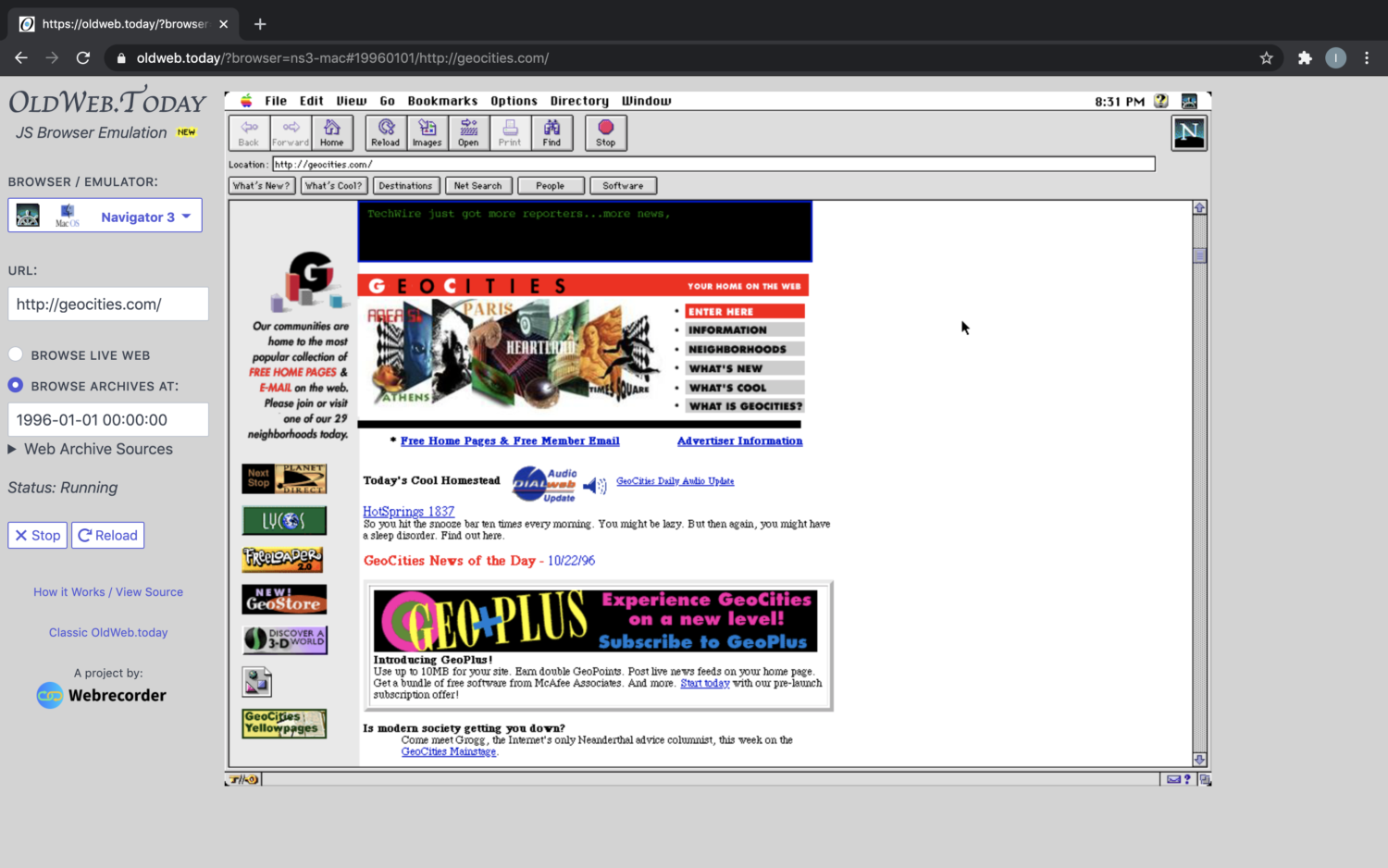
GeoCities was where a huge portion of the population made their first web page, organized into themed neighborhoods, complete with under-construction GIFs and visitor counters. Yahoo took the US site offline on October 26, 2009. The Japanese version outlived it by a decade.
GeoCities did not lose to a better page builder. It lost to the idea of a personal homepage being replaced by a profile on somebody else’s platform, which is a change in what the web was for rather than a change in software quality.
Adobe Flash is the biggest example of this on the whole list, and it was not a social platform at all. Adobe stopped supporting Flash Player on December 31, 2020. Flash was the runtime under an entire era of web games, animation, video players and interactive art. When it went, it did not take one site with it. It took the playable form of thousands of them at once.
Killed by Their Own Redesign
The rarest and most self-inflicted category.
Digg was, for a period in the late 2000s, the front page that decided what the tech web read that day. Its decline is usually traced to a redesign that reorganized the site around publishers rather than around what its users were voting up. The users who had been doing the voting left, mostly to Reddit, and the site was sold for a fraction of what it had been worth.
Digg is the cautionary example people reach for whenever a platform changes its feed, and the reason that comparison keeps getting made is that it is one of the few times a platform’s own product decision, rather than a competitor, did the damage.
The Four Ways, and What They Tell You
Put the list in order and the pattern is clean:
| How it died | Examples |
|---|---|
| A bigger platform took the users | Friendster, Orkut |
| The owner switched it off | Google Reader, Google+, AIM, Yahoo Answers, Vine |
| The foundation it stood on was removed | GeoCities, Flash |
| It changed into something its users did not want | Digg |
Only the first column is the story we usually tell, and it is the smallest column. The largest is the second, and the second column is not about competition at all. It is about the fact that when you build your work, your archive or your social life on someone else’s platform, the decision to end it is not yours and does not require you to have done anything wrong.
What Was Actually Lost
The platforms are the visible loss. The bigger one is quieter.
When GeoCities closed, millions of pages went with it, and what survives does so because volunteers archived it, not because anyone was obliged to keep it. When Yahoo Answers closed, so did a record of how people actually asked questions before search engines answered them. When Vine closed, six-second videos that had defined a period of internet humor became difficult to find in their original form.
None of that was anybody’s property in a way that protected it. The accounts were free, the terms allowed the shutdown, and the archive was a side effect of the business rather than a commitment.
That is the practical lesson from the old web, and it applies exactly as much to whatever you are posting on now.
The Same Pattern in Hardware
Platforms are not the only thing this happens to. The hardware version of the story runs alongside it and looks remarkably similar: products that were fine, discontinued for reasons that had nothing to do with quality. That thread runs through what happened to Palm and webOS, what happened to Windows Phone, and what happened to the Zune, and the broader sweep of it is collected in dead gadgets of the 2000s and 2010s.
The clearest hardware parallel to Google Reader is probably Google Glass: not beaten by a rival, just abandoned by the company that made it.
The Short Version
- Most of these platforms were switched off, not defeated. The owner’s strategy changed, and the product went with it.
- GeoCities went offline on October 26, 2009. Google Reader on July 1, 2013. Orkut in 2014. Friendster on June 14, 2015. Vine in January 2017. AIM on December 15, 2017. Google+ on April 2, 2019. Flash on December 31, 2020. Yahoo Answers on May 4, 2021.
- Digg is the outlier, the platform that did the damage to itself with a redesign.
- The archives were the real loss, and they survived only where volunteers chose to save them.