
Short answer: The Apple Watch, unveiled in September 2014 and released in April 2015, was not the first smartwatch, not the tenth, and arguably not even the most successful one at the time it launched. Microsoft sold SPOT watches with its MSN Direct data service from 2004 to 2008. Pebble’s Kickstarter campaign in April 2012 raised over $10 million, at the time the largest crowdfunding campaign ever run, and shipped a watch that had sold over one million units by 2014, before Apple had shipped a single unit of its own. Sony had a SmartWatch on the market by 2012, and Samsung launched the Galaxy Gear in September 2013, a full year before Apple’s announcement. What Apple actually did differently was arrive last, with a bigger app ecosystem, a health-tracking pitch, and enough marketing weight to turn a category that had existed in some form for a decade into a mainstream consumer purchase.
Everyone before Apple got at least one important piece right. None of them got all of the pieces right at the same time.
2004 to 2008: Microsoft’s SPOT, the smartwatch nobody remembers first
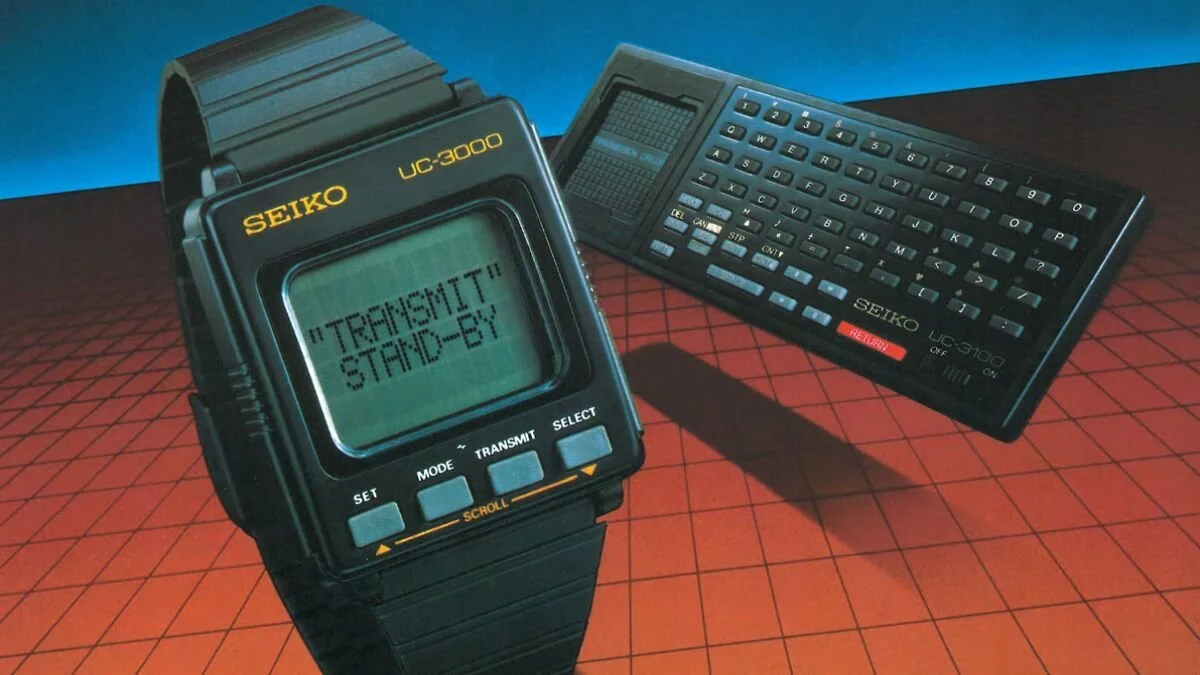
Microsoft’s earliest attempt predates the smartphone-era smartwatch story most people know by nearly a decade. SPOT, short for Smart Personal Objects Technology, was announced in 2003 and went on sale in 2004 through watchmakers including Fossil and Suunto. SPOT watches received data, sports scores, news headlines, weather, and stock prices, over an FM radio signal through Microsoft’s MSN Direct subscription service, which cost around $10 a month or $59 a year.
SPOT solved the “getting information onto your wrist” problem years before Bluetooth-paired smartwatches existed, but it required its own dedicated wireless infrastructure and a recurring subscription for a small amount of static information, with no interaction back to a phone since consumer smartphones as we now know them did not exist yet. Microsoft discontinued the watches in 2008, and the MSN Direct service itself was shut down entirely on January 1, 2012. It is a useful starting point precisely because almost nobody cites it: the idea of a connected wrist device is at least twenty years old, not ten.
2010 to 2012: the Bluetooth-companion era begins
The version of the smartwatch that actually resembles what exists today, a small connected screen paired to a smartphone over Bluetooth, took shape between 2010 and 2012, as smartphones themselves became common enough to pair with.
Sony released the LiveView in 2010, a small clip-on or wrist-worn screen that showed notifications, caller ID, and music controls from a paired Android phone. It looked more like a pager than a watch, but it established the core interaction model: the watch does not do the computing, the phone does, and the watch just surfaces what matters.
Sony followed with the SmartWatch proper in 2012, priced around $130, with a color touchscreen that paired specifically with Android devices and showed notifications, weather, and basic app data. Reviews were mixed, citing a limited app catalog and modest battery life, but it was a genuine, purchasable Android companion smartwatch two years before anyone had seen an Apple Watch.
April 2012: Pebble and the campaign that changed the category’s funding model
Pebble’s Kickstarter, launched in April 2012 by Eric Migicovsky, is the single most consequential event in pre-Apple Watch smartwatch history. It set out to raise $100,000 and instead raised more than $10 million from backers, at the time the largest Kickstarter campaign ever run, before a single unit had shipped.
Pebble’s pitch was different from Sony’s or Microsoft’s in one important way: an e-paper display instead of a full color touchscreen, which meant genuinely long battery life, often a week or more on a single charge, at a moment when every rival was measuring battery life in a day or two. It paired with both iOS and Android, unusual for the time, and supported a growing catalog of independent watch faces and apps. By 2014, Pebble had sold more than one million watches, entirely before Apple had shipped its first Apple Watch. Pebble’s own later story, including its eventual shutdown and its 2026 return under Core Devices, is covered in full at what happened to Pebble.
September 2013: Samsung Galaxy Gear, the first major manufacturer’s entry
Samsung launched the Galaxy Gear in September 2013, exactly one year before Apple’s Apple Watch announcement. It was the first smartwatch from a top-tier global phone manufacturer, not a startup or a niche accessory brand, and it packed in a camera and voice-call capability directly on the wrist, features few rivals had attempted. It paired exclusively with Samsung’s own Galaxy phones, a restriction that limited its addressable market from day one, and its battery life, closer to a day than a week, drew consistent criticism. Samsung iterated through several follow-up Gear models over the following two years, refining the formula without producing the breakout hit the launch had promised.
What all of these had in common, and why none of them broke through the way Apple’s did
Every device on this list solved at least one piece of the smartwatch problem well. SPOT solved getting information to the wrist. Sony’s LiveView and SmartWatch solved phone-paired notifications. Pebble solved battery life and cross-platform support. Samsung solved having a major manufacturer’s marketing and retail muscle behind the category for the first time.
None of them combined all of that with the two things that turned out to matter most for mainstream adoption: a large existing app ecosystem a buyer already trusted, and a health-and-fitness pitch specific enough to justify daily wear beyond checking notifications. That is the gap Apple’s entry filled in 2014 and 2015, not by inventing a new capability nobody had tried, but by being the company with both an enormous existing app developer base and a growing consumer interest in fitness tracking, arriving after five separate predecessors had already tested nearly every individual piece of the idea in public.
This is the same pattern that shows up across what happened to Google Glass: a category can be technically proven by several earlier attempts and still wait for the entrant with the ecosystem and marketing scale to make it a mainstream purchase rather than an early-adopter one.
Where each one stood in 2013, one year before Apple’s announcement
| Device | Launched | Key strength | Key limitation |
|---|---|---|---|
| Microsoft SPOT | 2004 | Wrist data over FM radio, no phone needed | Discontinued 2008; subscription-dependent |
| Sony LiveView | 2010 | Established phone-paired notification model | Small screen, limited functionality |
| Sony SmartWatch | 2012 | Full color touchscreen, real app catalog | Android-only, modest battery life |
| Pebble | 2012/2013 | Week-long battery, iOS and Android support | E-paper screen, limited third-party health integration |
| Samsung Galaxy Gear | Sept 2013 | Major manufacturer, camera and calls on wrist | Galaxy-exclusive, roughly one-day battery |
Do any of these older smartwatches still work in 2026?
It depends heavily on the model and how much of its function depended on a live service. Microsoft’s SPOT watches stopped functioning as designed the moment MSN Direct shut down in 2012, since the whole device depended on that data feed; they now work only as ordinary watches, if that. Sony’s LiveView and early SmartWatch models depend on companion apps that Sony has not meaningfully updated in years, and functionality on a current phone’s operating system is inconsistent. Samsung’s original Galaxy Gear similarly depends on companion software support that has lapsed for that specific model. Pebble is the notable exception: after its original 2016 shutdown, a dedicated open-source community, and later the original founder’s own 2026 relaunch under Core Devices, kept the platform’s core functions alive well past the point most of its rivals stopped working entirely.
The full index
The full index of the era’s discontinued hardware, grouped by what actually ended each one, is at the dead gadgets of the 2000s and 2010s. For the one device on this list that outlasted the rest, see what happened to Pebble. For Microsoft’s other early hardware bets from the same broader era, see what happened to the Xbox Kinect and what happened to the Zune.
A note on the numbers
Pebble’s Kickstarter total, over $10 million from an original $100,000 goal, and its one-million-unit sales figure by 2014 are drawn from Kickstarter’s own campaign records and contemporaneous reporting at the time, both widely and consistently cited. The Sony SmartWatch’s approximate $130 launch price and Samsung Galaxy Gear’s September 2013 launch date are drawn from each company’s own product announcements. Precise sales totals for the Sony LiveView, Sony SmartWatch, and original Samsung Galaxy Gear were never published by either company as audited figures, so this article describes their market reception qualitatively rather than attaching an invented unit count to any of them.
FAQ
What was the first smartwatch, before the Apple Watch?
There is no single agreed “first.” Microsoft’s SPOT watches, sold from 2004 to 2008, were an early connected-wrist device using an FM data service. The closer ancestor to today’s smartwatches, a Bluetooth companion to a smartphone, started with devices like Sony’s LiveView in 2010 and matured through Pebble and Samsung’s Galaxy Gear before Apple entered in 2014.
Did Pebble really outsell early competitors before the Apple Watch existed?
Pebble had sold more than one million watches by 2014, entirely before Apple shipped its first Apple Watch in April 2015, funded initially by a Kickstarter campaign that raised over $10 million in 2012.
Why didn’t Samsung’s Galaxy Gear become the dominant smartwatch?
It launched exclusively for Samsung’s own Galaxy phones, limiting its potential buyers to Samsung’s own customer base, and its battery life, around a day, was a consistent criticism. It also lacked the broader third-party app ecosystem Apple later brought to the category.
What made the Apple Watch succeed where these earlier devices didn’t?
Apple combined an existing large app-developer ecosystem with a specific, well-marketed health-and-fitness pitch, and it arrived after five years of earlier devices had already tested the category’s basic ideas in public, reducing the risk for a mainstream buyer trying it for the first time.
Do any pre-Apple Watch smartwatches still function today?
Most depended on companion software or services that have since lapsed. Pebble is the clearest exception, having been kept alive first by an open-source community after its 2016 shutdown, and more recently through the original founder’s own 2026 relaunch of the hardware.